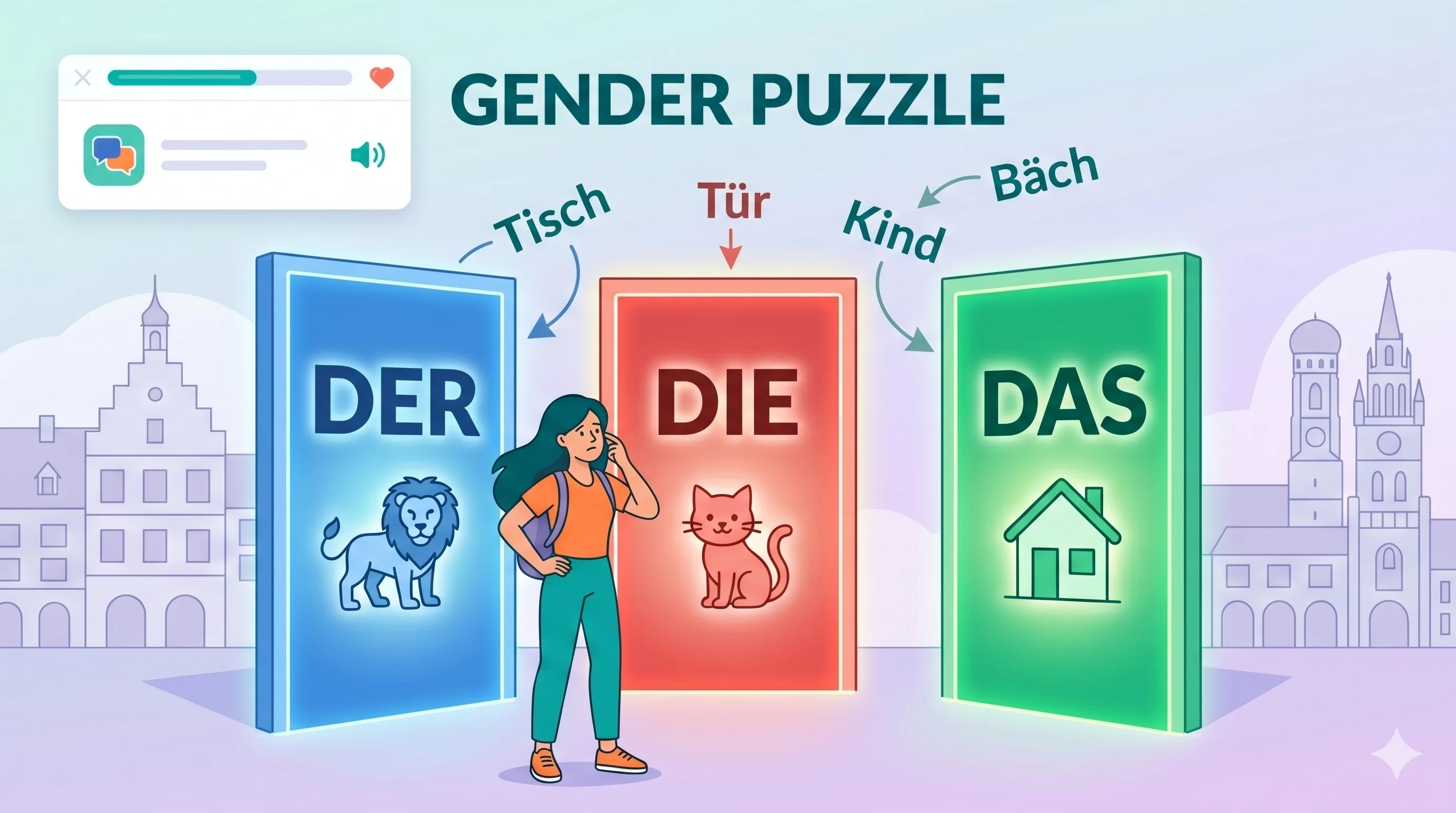
"Learning German articles is impossible" — ever said that to yourself? This feeling is incredibly common. But it is completely wrong. The problem is not your intelligence. It is the method you were taught.
Many people start learning German with enthusiasm, only to stumble at articles. Der or die or das? Three grammatical genders, dozens of rules, countless exceptions. And eventually — they quit.
Yet this difficulty is largely the product of poor teaching habits. Most native German speakers never memorised these genders — they internalised patterns. You can do the same.
Every noun in German has a grammatical gender. But "grammatical gender" does not follow real-world logic — which is exactly why brute memorisation fails. "Der Mond" (the moon) is masculine, "die Sonne" (the sun) is feminine, "das Mädchen" (the girl) is neuter. Stop looking for logic; the system makes its own rules.
"I have to memorise every word with its article, or I'll never learn them."
Around 70% of German nouns carry clues — in their sound, their ending, or their category — that let you predict the article. Pattern recognition, not memorisation, is what works.
This method is backed by dozens of neuroscience studies: the brain builds powerful associations between colour and meaning. Every time you learn a new word, write it in the colour that belongs to its article.
Whether you're writing flashcards, taking notes, or using a digital app — always use that colour. Over time, when you think of "Tisch," your mind will see blue first, then produce "der." You're not memorising the article; you're memorising the colour. And that's far easier.
Label items around your home with colour-coded post-it notes. "der Kühlschrank" (fridge) seen every morning while making coffee is quietly absorbed by your brain without any deliberate effort.
Many German words reveal their gender through their final letters. Learn these patterns once, and you'll be able to "predict" hundreds of words.
der Lehrer (teacher), der Frühling (spring), der Tourismus, der Faktor
die Wohnung (flat), die Freiheit (freedom), die Freundschaft (friendship), die Nation
das Mädchen (girl), das Büblein (little boy), das Dokument, das Zentrum
You don't need to memorise these rules. After encountering a few examples, you'll start recognising the patterns intuitively. This is exactly how language works.
The brain discards isolated information quickly. But information embedded in meaningful context is stored for a long time. That's why learning "die" as a standalone label is far less effective than learning it inside a sentence.
Not just "Wohnung" — but "Ich suche eine Wohnung in Berlin" (I'm looking for a flat in Berlin). The article sits naturally inside the sentence. Next time you see "Wohnung," your brain recalls that sentence and brings the article with it automatically.
Sentences with emotional resonance move to long-term memory far faster. Make your example sentences funny, personal, or memorable. They don't need to be correct — they need to be sticky.
Yes, German has words that follow no rule. Das Mädchen is neuter despite referring to a girl. Die Sonne is feminine despite the sun having no gender in nature. Don't let this bother you.
Native German speakers also get these wrong as children — and get corrected. You'll go through the same process. And that is perfectly normal. Rather than aiming for perfect accuracy, aim to be understood. Even if you say the wrong article, German speakers will follow you.
A German teacher once said something that sums it up: "Saying the wrong article is always better than saying nothing. Don't be afraid of the language."
Want to practise these three methods through real-life dialogues? Deutsch-Assistent helps you consolidate articles in context.
Start Practising →