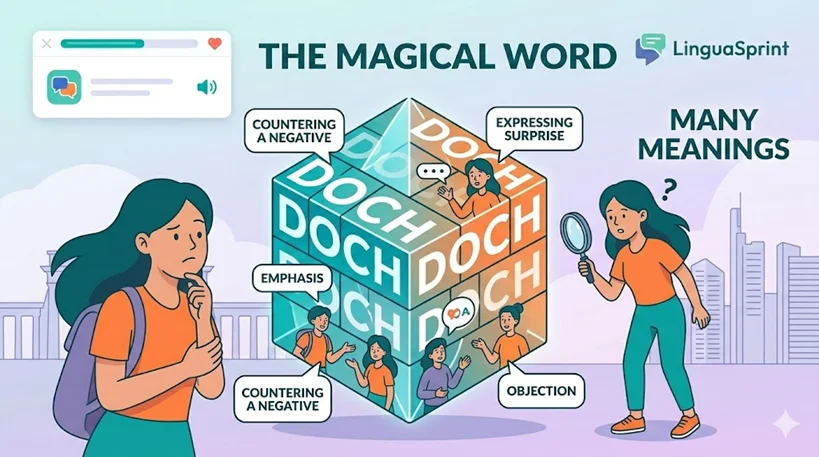
A German says something and right in the middle of the sentence comes "doch." You look it up: "but, yet, still, after all, actually…" None of them quite fits. Because "doch" doesn't live in the dictionary — it lives in context.
"doch" is probably the single word that gives German learners the most headaches. There's no English equivalent. There's no clean single translation. And Germans use it dozens of times every day.
Here's the secret: understanding "doch" is a sign that you've truly started to speak German. Because when you use it correctly, Germans narrow their eyes and think: "Ah — this person actually knows the language."
Let's meet all six versions of "doch" through real dialogues.
This is the most fundamental "doch." Someone denies or negates something, and you want to say: "No, that's not right — it is!" In English you'd just say "yes" — but in German, "yes" won't do. You need "doch."
Saying "Ja" here would be wrong — it would mean you're agreeing with the negative. "doch" does something specific: it says "I reject your negation."
Whenever you want to say "yes" to a negative statement, never use "ja" — always use "doch." This is one of the most critical reflexes in German.
This "doch" refers to information both speakers already share. It carries a gentle "well, obviously" or "as we both know" tone — not unkind, but pointed.
Think of the English "well" or "but you" — though neither is exact. "doch" here both reminds and carries a faint note of "I told you so."
"doch" placed in or at the end of a sentence can invite agreement — similar to "isn't it?" or "right?" in English. It's softer and more natural than those tags, though.
This "doch" softens the conversation and creates reciprocity. Used with "oder?" it sounds very natural and everyday — and using it makes you sound far more fluent in social settings.
In imperative sentences, "doch" shifts the emotional colour. Instead of a sharp command, it expresses mild impatience or nudging — the kind parents use with children, or friends use with each other.
"Ruf an!" is a command. "Ruf doch an!" is "oh for goodness' sake, just call" — far more human and conversational. When paired with "mal" — "Ruf doch mal an!" — the tone softens further still.
When something unexpected or upsetting happens, "doch" becomes a reactive expression — the verbal equivalent of "but… how?" It can even stand alone.
This "doch" is emotional. "Nicht doch!" carries the meaning of "Oh no, surely not!" — combining surprise and dismay in two syllables.
This is the most subtle "doch." The speaker is correcting or confirming their own thought — as if saying "actually, yes" to themselves. A quiet, internal yes.
"eigentlich doch" — "actually, on reflection, yes" — is one of the most natural and nuanced structures in everyday German. When you use this, Germans are genuinely impressed.
Not by memorising rules — by training your ear.
Next time you watch a German series or film, pause every time you hear "doch." Look at the context: which "doch" is this? This simple exercise, done consistently, builds the intuition over time. And one day you'll say "doch!" in exactly the right place — and Germans will smile with genuine surprise.
Words like "doch" — what linguists call Modalpartikeln, or "modal particles" — carry the soul of a language. Knowing them is the difference between a grammar student and a real speaker. It's not an academic transition; it's a human one.
Don't scatter "doch" into every sentence. Germans calibrate its frequency instinctively. Overused, it sounds forced rather than natural. Less but well-placed is always more powerful.
Remember: understanding "doch" fully means you've truly started to learn German. This small word is a large door into the language.
Want to practise "doch" in real dialogues? Test each usage with Deutsch-Assistent.
Practise "doch" →