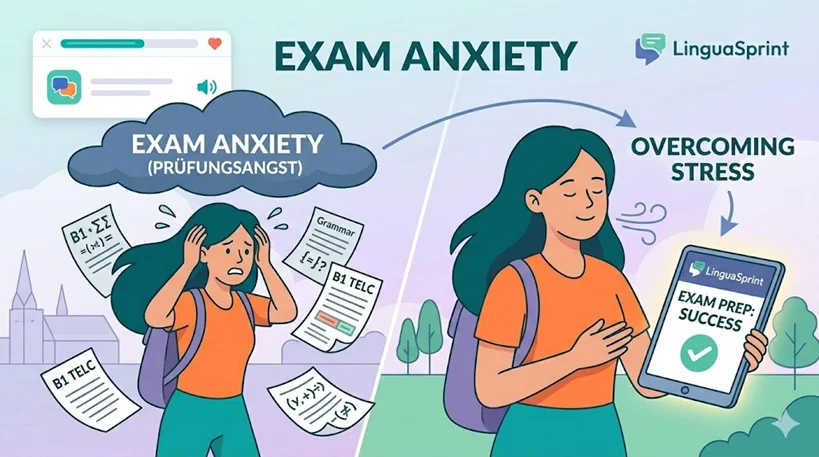
The B1 exam is not just a language test. For many people it feels like an identity test. Thousands of people have spent years preparing only to find their mind going blank on the day. The problem wasn't their German — it was how they managed anxiety.
For immigrants in Germany, the B1 exam often carries weight far beyond a simple language assessment. Residency renewal, citizenship applications, job searches — many of these hinge on this one test. And the heavier that weight, the bigger the anxiety.
Does that anxiety point to a real problem? Usually not. Research shows that test anxiety systematically conceals actual knowledge. Some people don't fail because they don't know the material — they fail because their brain "shuts down" at the critical moment.
In this post, we'll cover both the structure of the exam and four concrete strategies to prevent that shutdown.
Whether you're sitting Goethe-Institut, telc, or ÖSD, the B1 exam structure is broadly similar. Four core skills are assessed:
Everyday conversations, announcements, short dialogues. Pace and emphasis can catch you off guard.
News articles, notices, and short texts. Comprehensible even without knowing every word.
A formal or semi-formal letter or email. Structure and tone matter more than perfect grammar.
The section most candidates fear most. Spontaneous production in front of an examiner.
The B1 exam does not test "perfect German." It tests whether you can communicate functionally in everyday situations. This changes everything: making mistakes won't fail you — being incomprehensible will.
Under high stress, the amygdala — the brain's threat-detection centre — activates and temporarily suppresses prefrontal cortex function. The prefrontal cortex is precisely where we process language, organise words, and build grammar. When anxiety "shuts down" this region, knowledge doesn't disappear — it becomes temporarily inaccessible.
Why does this matter? Because it explains: "I forgot everything in the exam" is not actual knowledge loss — it is a temporary access problem. And this problem has solutions.
Perceiving an exam as a judgement session automatically triggers the amygdala. But what are examiners actually doing? Listening to a conversation and noting whether they understood you. At its core, this is a communication moment.
"The examiner is noting every mistake. If I say something wrong, I'll fail."
"This person is having a German conversation with me. I want to be understood — not perfect."
"This exam determines my entire future. I cannot fail."
"This exam is an opportunity. If I don't pass, I can retake it — this is a step, not a finish line."
Much of anxiety feeds on the unknown. If the first time you experience an "official setting" is on exam day, your brain codes it as a threat. The solution: let that feeling find you repeatedly before the exam, so that on the day itself it feels familiar.
Elite athletes "visualise" before competition — they live through the race in their minds repeatedly. The same technique works for a language exam: mentally walk through exam morning, entering the room, making eye contact with the examiner. The brain sees little difference between a real experience and a vivid mental simulation.
The most common mistake in exam preparation is constantly focusing on areas where you're weakest. This erodes both motivation and confidence. The B1 exam doesn't require knowing everything perfectly — it requires using what you know with confidence.
Spending the last week before the exam cramming complex structures like Konjunktiv II or Genitiv. Getting these half-right can actually be more damaging than not knowing them at all.
Instead, build a reliable repertoire: sentence structures, transition phrases, and set expressions you can use correctly even under exam pressure.
High-power postures (standing tall, taking up space) lower cortisol and increase the sense of confidence in as little as 2 minutes. Standing upright in the bathroom for 2 minutes before the exam has measurable psychological effects — this isn't speculation, it's a replicated finding.
Making mistakes in the B1 exam is inevitable. Native German speakers make mistakes in everyday conversation too. Examiners know this — and expect it.
What matters is not avoiding mistakes — it is being able to continue after one. The difference between a candidate who stumbles, blushes, and over-apologises, and one who makes a mistake and moves naturally forward, is reflected clearly in the final score.
When you make a mistake, say "Weiter!" (Keep going!) in your head. The exam assessment looks at overall performance — not a single slip. The ability to recover is worth far more than flawlessness.
Passing this exam won't make you a fluent German speaker. But it moves you to the next level — both in the language and in your life in Germany. And the value of that transition goes far beyond the test score.
If you have anxiety, that is completely normal. That anxiety shows that this exam matters to you. Feeling nervous about things that matter is a deeply human response. The only thing you need to do is keep going — in spite of it.
A consistent observation from people who've sat the B1 exam: "It was actually far less scary than I expected." The mind always makes the unknown bigger than it really is. The best preparation is shrinking the unknown — and now you have four concrete tools to do exactly that.
Want to practise the B1 speaking and writing sections with real exam scenarios? Test yourself with Deutsch-Assistent.
Start B1 Practice →