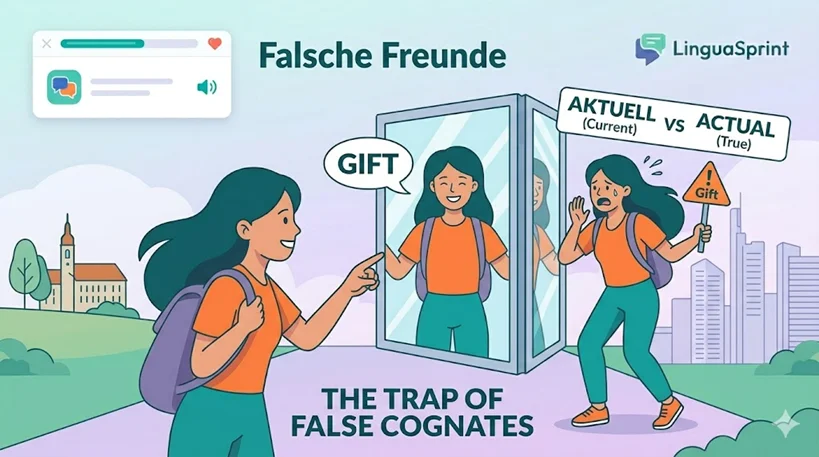
Knowing English is an advantage when learning German — but it also creates a dangerous kind of overconfidence. Some words look so familiar that your brain switches to autopilot. And that's exactly when the trap closes.
Linguists call this phenomenon "faux amis" — or false friends. Familiar on the surface, treacherous underneath. German has plenty of them, especially for English speakers whose eyes (and brains) skim past unfamiliar words and land on the ones that feel known.
Here are eight of the most notorious false friends in German — and how to make sure you never fall for them again.
Thought to mean: to become, to turn into
To receive, to get, to be given something
"bekommen" → something is coming to you. For "to become," use "werden."
Thought to mean: as well, in addition, additionally
A concluding conjunction: so, therefore, then, well
"also" in German always signals a result or a transition. For "additionally," use "auch."
Thought to mean: real, genuine, actual
Current, present, up to date, the latest
"aktuell" → what is relevant right now. For "real / genuine," use "eigentlich" or "tatsächlich."
Thought to mean: sensible, reasonable, level-headed
Emotionally sensitive, perceptive, finely attuned
"sensibel" → like a sensor, picking up on everything. For "sensible / reasonable," use "vernünftig" or "sinnvoll."
Thought to mean: eventually, sooner or later, in the end
Possibly, perhaps, if it comes to that
"eventuell" → uncertainty, possibility. For "eventually / sooner or later," use "irgendwann" or "schließlich."
Thought to mean: sympathetic, feeling compassion for others
Likeable, pleasant, easy to warm to
"sympathisch" → a pleasant, appealing personality. For "feeling compassion," use "mitfühlend."
Thought to mean: ordinary, standard, unremarkable
Vulgar, crude, coarse — a significant insult
For "ordinary / everyday," use "gewöhnlich" or "normal." Using "ordinär" in the wrong context is social dynamite.
Thought to mean: pregnant, expecting a child
Concise, pithy, expressed with striking clarity
"prägnant" → striking sharpness of expression. For pregnancy, use "schwanger." This mix-up has caused memorable moments in office meetings across Germany.
You're not the only one who's fallen into these traps. Millions of immigrants and expats living in Germany have stumbled over each of these at least once. The "prägnant" situation has produced laughter in offices across the country. Making the mistake isn't embarrassing — it's the most memorable way to learn.
These eight are just the tip of the iceberg. German has dozens more false friends: "Gift" (poison), "bald" (soon), "Chef" (boss — not head chef), "Handy" (mobile phone). The further you go into the language, the more surprises you find — and the more fun they become.
Knowing English is an advantage in German — that's real. But the reflex of "this word looks like English so it probably means the same thing" is the most dangerous trap of all. Learning when to slow down and question that reflex is one of the most valuable skills in language learning.
Want to practise these words in real sentences so you never mix them up again? Deutsch-Assistent puts false friends in context.
Practise False Friends →