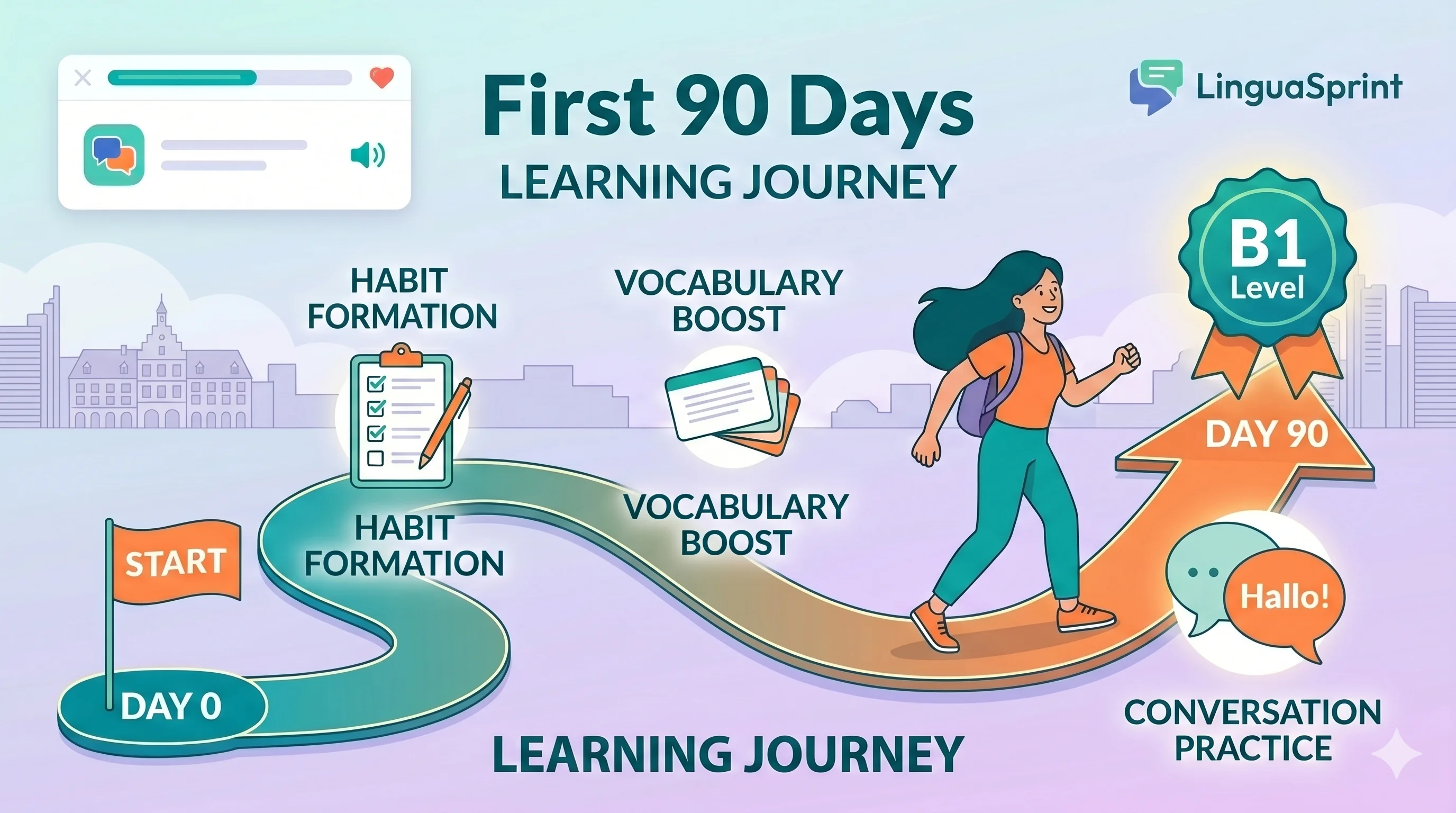
When you step off the plane, learning German is right at the top of your list. Then real life takes over. This guide covers how to navigate those first 90 days — and exactly when language learning fits into the picture.
Arriving in Germany for the first time has its own particular feeling. The signs at the airport seem familiar — you've studied some German, after all. But once you leave passport control, reality begins. A new country, a new system, a new rhythm. And you're still figuring out where to go, let alone whether your "Entschuldigung" will come out without trembling.
The first 90 days are not the time for perfect German. They are not even the time for "fully settling in." This period is about one thing only: laying the foundation. And if you do that well, language learning lands on far more solid ground.
Give yourself one single goal for the first month: get the bureaucratic foundation in place. You don't need to speak perfect German this month. But there are processes you cannot afford to delay — because in Germany, bureaucratic delays create chain reactions.
Without Anmeldung you can't open a bank account, and without a bank account many contracts won't go through. Break this chain early — appointment slots fill up quickly.
Keep your German expectations low this month — but not at zero. Fifteen minutes a day is enough. Focus on one thing only: survival vocabulary. Bitte (please), Danke (thank you), Entschuldigung (excuse me), Wo ist…? (where is…?), Ich verstehe nicht (I don't understand). These handful of words will get you through most of Germany.
If you feel constantly overwhelmed this month, that is entirely normal. "Culture shock" is a real psychological process — the brain temporarily reduces its capacity as it adapts to a new environment. Be gentle with yourself.
The most critical paperwork is done and your mind has a little room to breathe. This period is for settling into daily life — and for genuinely making space for language learning.
Planning German as a separate activity rarely works — because you're already tired. Instead, fold it into what you already do.
A consistent observation among immigrants who've lived in Germany for years: real language progress came not from deliberate study sessions, but from embedding the language in daily routine. The breakthrough happened not when they were "trying to learn" — but when they were "using it without thinking."
Loneliness is the biggest trap of this period. Communities who speak your language are a safe harbour — but staying there permanently blocks language progress. Finding the balance matters.
If you're at day 60 and still waiting for the "right moment" to start German — that moment will never come. Now is the right time. Because you have something you didn't have before: context.
You live in Germany now. Bureaucratic words are familiar, you know your neighbourhood's name, the bakery you go to every morning, the U-Bahn line you take. The most powerful fuel for language learning is real-life context — and you're swimming in it.
The feeling of "why am I progressing so slowly?" is extremely common in days 61–90. It's misleading. The brain is processing all the raw data it collected in the first two months. Invisible progress is happening. Patience is the greatest virtue here.
Not "am I speaking perfect German?" Never ask that question.
The right question is: "Did I understand something today that I didn't understand yesterday?"
If the answer is yes — you progressed. Speed doesn't matter. Direction does.
Moving to Germany was already a huge step. Learning the language is the second act of courage on top of it. No one expects you to do both perfectly at once. Give yourself the same patience throughout your language journey that you showed yourself in those first 90 days.
Ready to practise German through everyday German life scenarios? Deutsch-Assistent is by your side with real-life dialogues.
Start Your Daily German Practice →