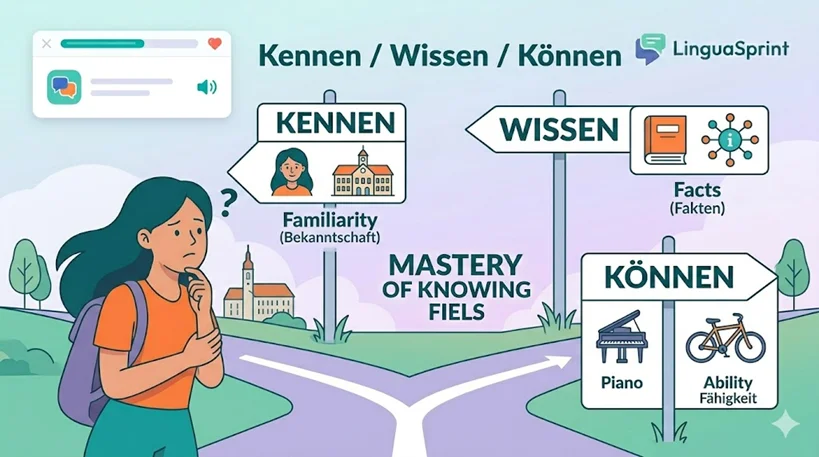
In English, "to know" covers everything. In German, three entirely different verbs share that territory. And confusing them doesn't break your grammar — it breaks your meaning. Which makes it a subtler, and trickier, kind of mistake.
Almost everyone who gets their German to a certain level runs into this trio: kennen, wissen, können. They all translate as "to know" — but they describe completely different kinds of knowing. Pick the wrong one and your sentence still sounds grammatically fine. Yet what you've said is something quite different from what you meant.
Let's draw clear lines between all three.
"kennen" describes direct, personal familiarity. You know a person, a city, a film, a restaurant, or a book because you've experienced it firsthand. Not through abstract information — through actual encounter.
"kennen" always implies a direct relationship with its object. You've met the person, been to the city, read the book — that experience is what produces "kennen." You cannot use "kennen" for a city you've never visited or a person you've never met.
"kennen" → personal contact. Think of recognising a face, a place, a taste, or a sound. Knowledge gained through your five senses is "kennen."
"wissen" describes abstract, intellectual knowledge. A fact, a date, an address, a rule, an answer — knowing these things is "wissen"'s territory. No direct experience or personal acquaintance is needed; the information in your head is enough.
"wissen" typically pairs with "dass" or question words like "wo, wann, wie, warum" — because you're dealing with a fact, location, or time you have information about. This pairing is one of "wissen"'s clearest signals.
"wissen" → encyclopaedic knowledge. If you could google it, read it in a book, or answer it on a test — that's "wissen."
"können" describes ability or capacity. Swimming, speaking German, playing the piano — these are learned skills, and "können" is exactly where they belong. "Being able to" or "knowing how to" is "können"'s home.
"können" can also stand alone with a language name: "Ich kann Deutsch" — I know German, I can speak it. This short form is very natural and common in everyday speech.
"können" → capacity. Whether it comes from training, practice, or natural ability — if you can do something, that's "können."
Same restaurant, three different relationships: familiarity, information, ability. This threefold distinction isn't unique to German — French has connaître/savoir, Spanish has conocer/saber. But because English covers all three with one word, the distinction doesn't come naturally at first.
| Verb | What it describes | Object type | Example |
|---|---|---|---|
| kennen | Personal familiarity | Person, place, work | Ich kenne ihn. |
| wissen | Knowing a fact | Information, data, truth | Ich weiß es. |
| können | Ability, skill | Skill, capacity, language | Ich kann schwimmen. |
"Ich weiß Deutsch" — wrong. German is a skill, not a piece of factual information. The correct forms are: "Ich kann Deutsch" or "Ich spreche Deutsch." Never use "wissen" with language names.
This three-way distinction reveals how a language divides up the world. English covers all three with one word — German gives each relationship its own verb. Neither is richer; both are different. And this difference is exactly what makes German fascinating.
Once you've internalised these three verbs, understanding the difference between "lernen" (to learn) and "verstehen" (to understand) becomes much more intuitive. Every distinction you grasp opens the next one. That's how language really works.
Want to practise kennen, wissen, and können in real dialogues? Deutsch-Assistent puts them in context.
Practise All Three →