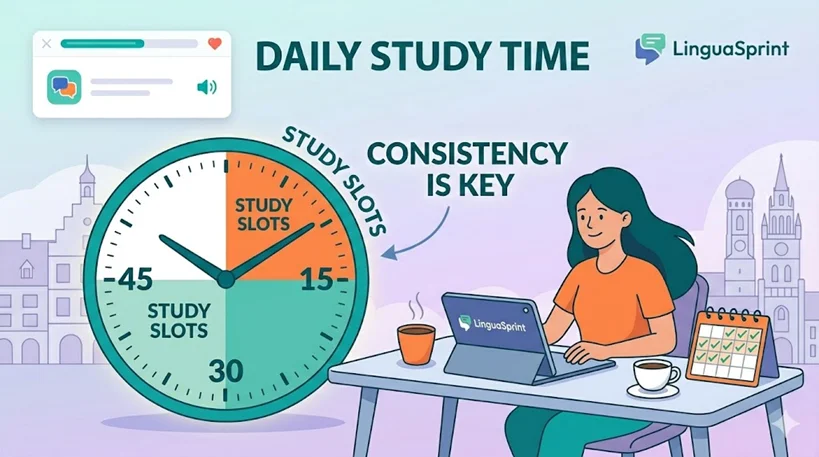
If you've been putting off German because you "don't have enough time," this post dismantles that excuse with science — and replaces it with a far more practical framework.
One of the biggest myths in the world of language learning is this: getting results requires hours of study every day. This belief has stopped many people before they've even started.
So what does the science actually say? The answer is both surprising and reassuring.
"How many hours a day do I need to study to learn German faster?"
"How long, at what intensity, and how frequently do I need to study to make the most of my brain's learning capacity?"
The difference looks small but the results are enormous. Language learning is a marathon, not a sprint. And the brain is fed not by long, infrequent sessions — but by short, consistent repetition.
Hermann Ebbinghaus's "forgetting curve" research shows that a large portion of newly learned information is lost within the first 24 hours. The most effective counter to this is not one long session, but short repetitions spread across the day. A brain that encounters the same word today, tomorrow, and three days later retains it for months.
Modern learning science consistently shows that focused 10–15 minute sessions are often more effective than 60–90 minute unfocused ones. The reason: the brain cannot sustain high concentration for long periods, and when fatigued, it fails to transfer new information to long-term memory.
Linguist Stephen Krashen argues that language acquisition is the product not of deliberate memorisation, but of meaningful, regular "input." In other words: 20 minutes a day of meaningful German engagement beats three hours of "studying" once a week by a significant margin.
But there's an important distinction here: these 20–30 minutes need to be quality minutes. Half-glancing at your phone, studying "on the side" while watching something — that doesn't count.
Quality minutes mean: fully focused, with active mental engagement on a single task.
Everyone's life is different. Finding "30 minutes a day" feels easy for some people and nearly impossible for others. Look at the profiles below and find the one closest to you.
Morning coffee + lunch break. Two 7.5-minute sessions beat one 15-minute block.
Podcast while cooking or during nap time. Consistent and small beats nothing.
Two blocks: 15 min new content + 15 min review. Add one extra session on weekends.
Daily life already covers ~40% of your practice. Structured 20 min completes it.
How you spend your 20 minutes matters far more than the fact that you spend 20 minutes. Here is a brain-friendly session structure:
Try to recall yesterday's words or sentences without looking at your notes. This act of retrieval is the mechanism that transfers information into long-term memory.
New vocabulary, a new grammar point, or a new dialogue. Focus on one thing — covering two topics in this window leaves both shallow.
Put what you've learned into a sentence. Write it, say it aloud, or practise it in an app. This step is how passive knowledge becomes active memory.
People who use this structure often notice that they retain far more from 20 focused minutes than from hours of unfocused "studying." The brain doesn't respond to volume — it responds to structure.
Three days a week at one hour each? Or every day at 20 minutes?
The research is clear: frequency is always more important than duration. The more often the brain is exposed to a language, the more it encodes it as "part of daily life." Once that encoding happens, learning starts to shift from conscious effort to something more automatic — and that is when the language truly begins to feel like yours.
Prefer finishing an imperfect session to planning a perfect one. Sustainable and irregular always beats perfect and occasional.
"I don't have enough time" is a real feeling — but usually a misleading one. If you have time for a cup of coffee, time to listen to a song, time to scroll for a few minutes — you have time for German.
The problem is not time. It is prioritisation. And prioritisation gets easier when you have a strong answer to the question "why." Think about the life you are building — or want to build — in Germany. That is your most powerful timer.
Want to spend your 20 minutes on structured, context-rich practice? That's exactly what Deutsch-Assistent is designed for.
Build Your 20-Minute Plan →