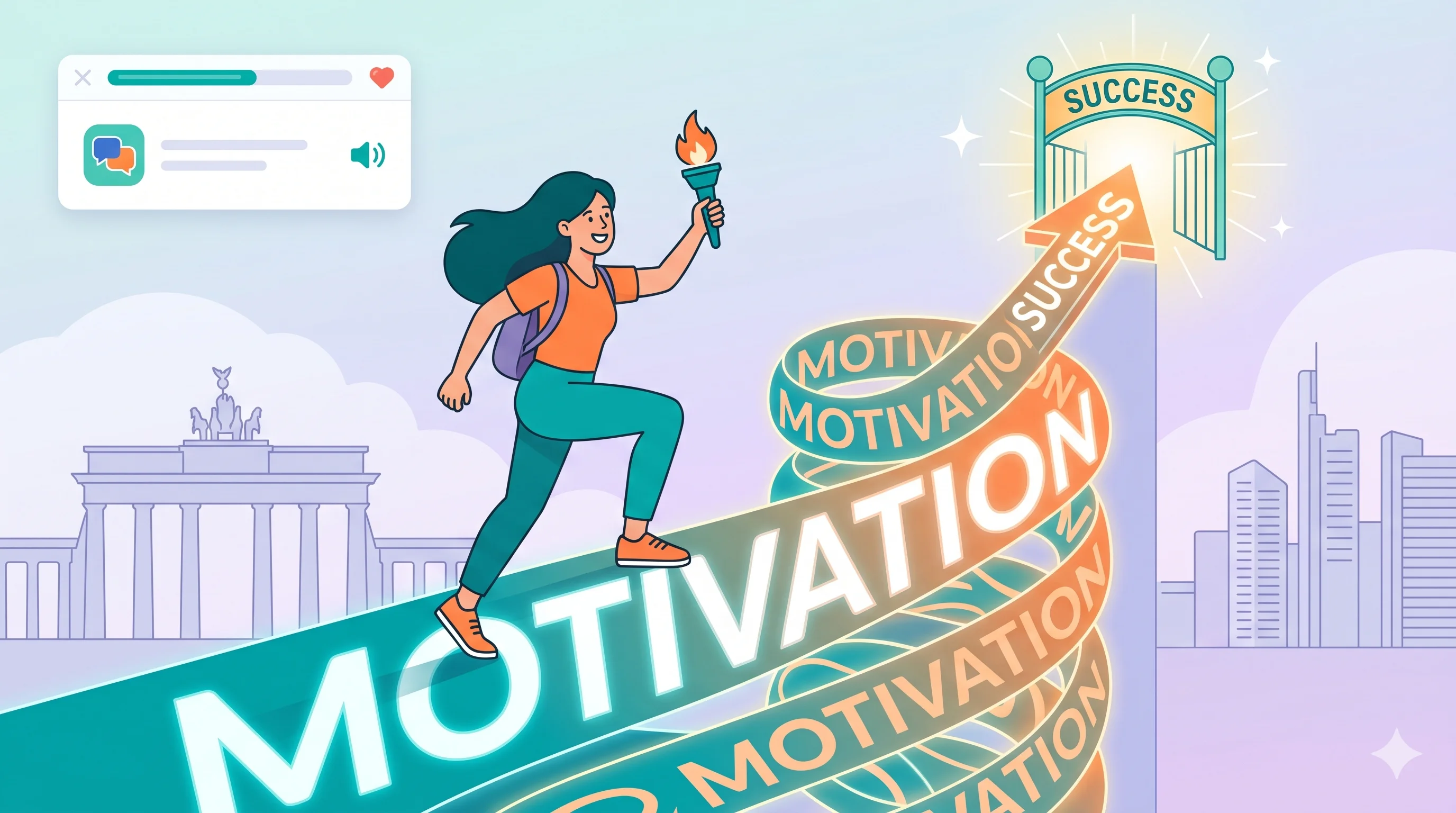
When you first arrived in Germany, learning German was at the top of your list. Then real life began. And your motivation quietly started to fade. This post is about exactly that moment.
Moving to Germany takes courage. A new system, new rules, a new culture — and on top of all that, a foreign language to learn. Most people start out with conviction: "I am going to learn this language." But as the weeks go by, that initial fire begins to dim.
This is not a willpower problem. It is entirely a psychology problem.
Linguists call this "adaptation fatigue." In a new country, everything consumes your mental bandwidth: bureaucratic processes, cultural differences, social isolation, work stress. While your brain is busy managing all of this, long-term goals like language learning get quietly pushed to the back.
Add to this what we might call the "workaround trap": Google Translate is there, English speakers are around, community groups exist. "I'll manage today" becomes a habit — and days turn into weeks.
Motivation is a starting gift — you cannot rely on it to last. What is sustainable is not motivation itself, but habit and a sense of consistent progress.
The brain runs on the feeling of success. Instead of targets like "I'll reach B2 this month," set micro-goals you can actually tick off — "I learned three new words today." These small victories release dopamine and make it easier to keep going.
When you use a word you just learned in real life, your brain locks it in. Practice not just through apps or textbooks, but inside everyday life. Read labels at the supermarket, try small exchanges with your neighbour, watch a German series — focus not on how much you understand, but on how much you try.
Switch your phone's language to German. The interface you see hundreds of times a day will quietly build your vocabulary without you even noticing.
In immigrant psychology, this is one of the most destructive feelings: "I've been here six months and I'm still speaking my native language — how embarrassing." This feeling is misplaced. Learning a language in adulthood is a fundamentally different process from childhood acquisition, and it naturally takes more time. Compare yourself to who you were yesterday, not to your peers.
Language is a social skill; it does not thrive in isolation. Find a Tandem partner, join a Stammtisch (a language meetup for foreigners), or become part of a digital learning community. When someone knows you and sees your progress, giving up becomes much harder.
Finding a job? Playing a more active role in your child's school? Having a genuine conversation with your neighbour? Your real reason for learning German is an emotional connection. Make that connection visible — write it on a piece of paper, set it as your phone wallpaper. In difficult moments, your "why" will give you direction again.
Der, die, das… The first wall almost every German learner hits. But this system has a logic to it — and once that logic is understood, articles stop being something to memorise and start becoming something you sense. Through colour coding, contextual repetition, and consistent practice, this wall becomes something you can actually climb.
We'll dedicate a full post to this topic. For now, know this: not being able to memorise articles does not mean you are not intelligent — it simply means you haven't yet found the right method.
Want to practise German through real-life scenarios? Deutsch-Assistent is built exactly for that.
Explore the App →