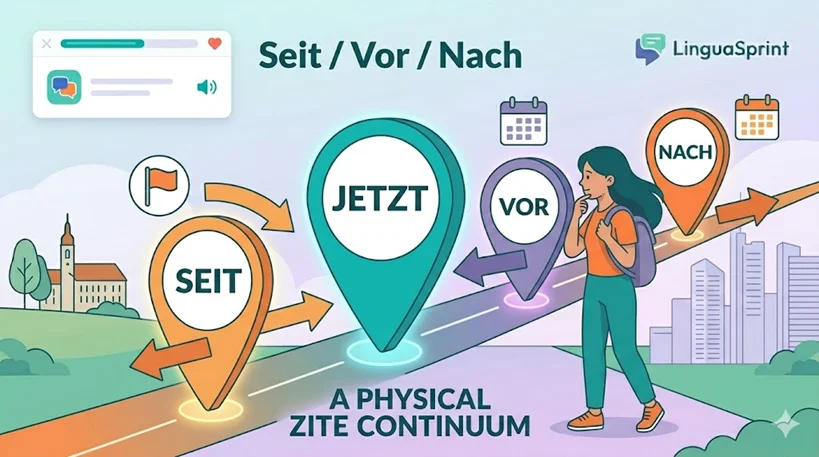
"Two years ago," "for two years," and "after that" are clear distinctions in English. German makes the same distinctions — but which tense each one demands is where things get confusing. Once you grasp one rule, everything clicks.
These three words appear regularly in exam questions, come up constantly in everyday conversation, and are a frequent source of written errors. The underlying logic is actually quite simple: each one points to a different position or movement in time.
"seit" triggers one of the most distinctive structures in German: for situations that started in the past and are still ongoing, German uses the present tense (Präsens) — not the past. In English you'd say "I have lived here for three years." In German, the verb stays present. This is the source of the most common mistake with "seit."
"Ich habe seit drei Jahren hier gewohnt" — wrong. If you're still living there, do not use the past tense. "seit" + Präsens = ongoing situation. This rule works with almost no exceptions.
"seit" → like "since": there's a starting point, and a line stretches from that point to right now. If the line is still running, the verb stays in the present tense.
"vor" works like the English "ago": it counts backward from the present moment to a completed past event. That action is over — it is not continuing.
"vor" → like "ago / before": a distance backward from now. Used with past tense (Perfekt or Präteritum) — what happened has happened.
"Ich bin vor drei Jahren nach Deutschland gekommen" (I came to Germany three years ago — arriving is finished.) and "Ich lebe seit drei Jahren in Deutschland" (I've been living in Germany for three years — still living there.) describe the same person's same life. But German uses two different verbs and two different tenses. Understanding this distinction transforms how you talk about time.
"nach" is versatile: it means both "after something" and "toward somewhere." In time contexts, it always takes an event as its reference point and describes what follows it.
"nach" → "after / toward": either something that follows an event, or movement in a direction. Requires Dativ: "nach dem Essen", "nach der Arbeit", "nach Hause."
The difference between "nach Hause" (I'm going home — movement) and "zu Hause" (I'm at home — location) is hiding in plain sight here. "nach" describes movement, "zu" describes position. Confusing these two is one of the most common everyday mistakes in spoken German.
| Word | What it describes | Tense | English equivalent |
|---|---|---|---|
| seit | Ongoing situation | Präsens (present) | "for / since" |
| vor | Completed past moment | Perfekt / Präteritum | "ago" |
| nach | After an event / direction | Both tenses | "after" |
Once you've internalised these three, "seitdem" (since then), "davor" (before that), and "danach" (after that) become very easy to pick up. They're all extensions of the same logic — and they're indispensable for telling stories in everyday German.
Using time correctly in German is one of the most poetic parts of the grammar. The difference between "seit" and "vor" really asks: are you still inside this moment, or have you left it behind? German cares about that distinction enough to demand its own structure for each. That's what makes it such a precise language.
Want to practise seit, vor, and nach in real sentences? Deutsch-Assistent puts them in context.
Practise Time Words →