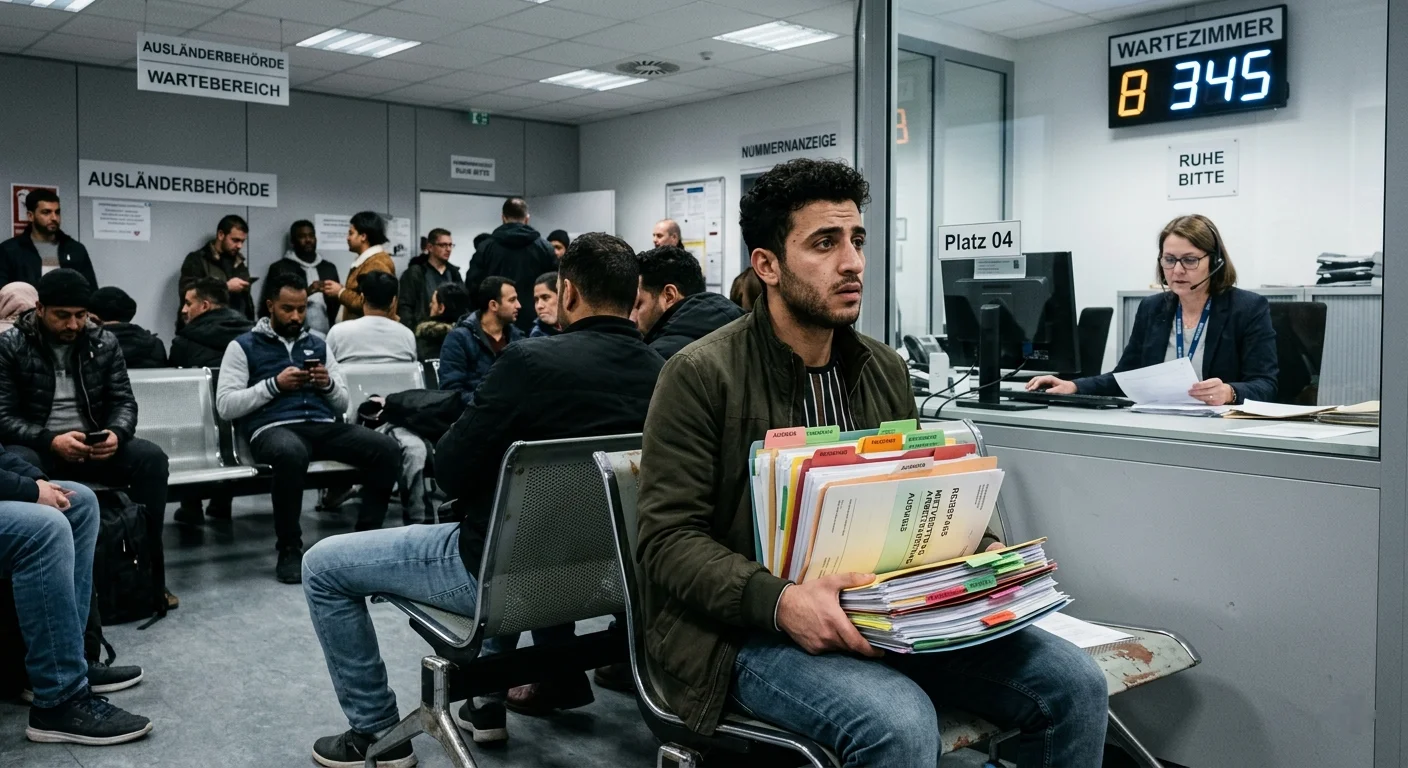
Surviving Germany — #01
Bureaucracy & Admin
German at the Ausländerbehörde: Every Phrase You Need, Start to Finish
Reading time: ~15 minutes · Bookmark this before your appointment · All levels welcome
The Ausländerbehörde is where immigration documents get extended, residency permits get issued, and a lot of people's nerves get thoroughly tested. Whether you have a simple renewal or a complex case, this guide gives you the exact German you need — from booking the appointment to walking out the door.
For many immigrants in Germany, the Ausländerbehörde is the single most stressful place to walk into. The stakes are high, the vocabulary is specialised, and the officers — though they're just doing their jobs — rarely slow down for non-native speakers. The combination of legal terminology, formal German, and real consequences makes this appointment unlike any other.
This guide covers the full journey: booking, arriving, checking in, sitting in the waiting room, talking to the officer, understanding what they're asking for, handling confusion, and leaving. Read it through before your appointment, then come back to the specific section you need.
What's in this guide
- 01 Essential vocabulary first
- 02 Booking your Termin
- 03 What to bring
- 04 Arriving & checking in
- 05 In the waiting room
- 06 With the officer
- 07 Common scenarios
- 08 When you don't understand
- 09 Difficult moments
- 10 Leaving & follow-up
- 11 Phone call phrases
- 12 Full survival card
01
Essential vocabulary — know these before you walk in
The Ausländerbehörde has its own language. These are the words you will hear, see on signs, and need to use. Familiarise yourself with them before the appointment so you're not processing vocabulary and meaning at the same time.
der Termin
appointment
You cannot walk in without one in most cities.
die Aufenthaltserlaubnis
residence permit
The most common reason for visiting.
die Niederlassungserlaubnis
permanent residence permit
Unlimited — the goal for many long-term residents.
die Aufenthaltsgenehmigung
permission to stay / residence authorisation
Older term, sometimes still used informally.
das Visum
visa
Entry visa — different from a residence permit.
verlängern
to extend / renew
"Ich möchte meine Erlaubnis verlängern."
beantragen
to apply for
"Ich möchte eine Erlaubnis beantragen."
die Unterlagen / Dokumente
documents / paperwork
They will almost certainly ask for these.
der Reisepass / Personalausweis
passport / ID card
Always bring the original.
die Anmeldung / Meldebescheinigung
registration / proof of registration
Your official address registration document.
der Arbeitsvertrag
employment contract
Required for work-based permits.
der Nachweis
proof / evidence
"Haben Sie einen Nachweis?" — do you have proof?
die Gebühr
fee / charge
Most permits require a payment — bring cash and card.
das Formular / der Antrag
form / application
You may need to fill one in before or during the appointment.
der Sachbearbeiter / die Sachbearbeiterin
the officer / caseworker
The person handling your case.
das Warteticket / die Nummer
queue ticket / number
Take one from the machine when you arrive.
gültig / abgelaufen
valid / expired
Check: "Ist mein Aufenthalt noch gültig?"
die Frist / die Fälligkeit
deadline / due date
Critical to know when renewing before expiry.
der Aufenthaltsstatus
immigration / residency status
Your current legal position in Germany.
die Bescheinigung
certificate / official confirmation
Often issued at the end of your appointment.
One phrase to know above all others: "Können Sie das bitte aufschreiben?" — "Could you write that down please?" If you can't catch a word or document name, ask them to write it. No one will think less of you for it.
02
Booking your Termin — online and by phone
In most German cities, the Ausländerbehörde operates entirely by appointment. Walk-ins are often turned away. Appointments are booked online through the city's portal — look for "Termin buchen" or "Online-Termin" on the official website. In Berlin it's the Landesamt für Einwanderung (LEA); in Munich it's the Kreisverwaltungsreferat (KVR). Each city has its own system.
If you can't book online — or the system shows no availability — you may need to call. Here is what a phone booking sounds like:
Booking by phone — Terminvereinbarung am Telefon
Office
Ausländerbehörde München, guten Tag.
Foreigners' Registration Office Munich, good day.
You
Guten Tag, ich möchte gerne einen Termin vereinbaren.
Good day, I would like to make an appointment.
Office
Worum geht es? Was ist der Grund Ihres Besuchs?
What is it regarding? What is the reason for your visit?
You
Ich möchte meine Aufenthaltserlaubnis verlängern. Sie läuft am [Datum] ab.
I would like to extend my residence permit. It expires on [date].
Know your expiry date before you call — they will ask.
Office
Wie ist Ihr Name und Ihre Nationalität?
What is your name and nationality?
You
Mein Name ist [Name]. Ich bin [Nationalität].
My name is [Name]. I am [nationality].
Office
Wir haben einen freien Termin am [Datum] um [Uhrzeit] Uhr. Passt Ihnen das?
We have a free appointment on [date] at [time]. Does that work for you?
You
Ja, das passt mir gut. Vielen Dank.
Yes, that works well for me. Thank you very much.
You
Können Sie mir bitte sagen, welche Unterlagen ich mitbringen soll?
Could you please tell me which documents I should bring?
Always ask this — save yourself a wasted trip.
Useful phone phrases
| German | English |
|---|
| Können Sie bitte langsamer sprechen? | Could you please speak more slowly? |
| Könnten Sie das bitte wiederholen? | Could you please repeat that? |
| Können Sie mir das bitte buchstabieren? | Could you please spell that for me? |
| Ich bin leider verhindert — kann ich umbuchen? | I'm unfortunately unavailable — can I rebook? |
| Wann ist der früheste verfügbare Termin? | When is the earliest available appointment? |
| Gibt es eine Warteliste? | Is there a waiting list? |
| Wie lange dauert der Termin ungefähr? | How long does the appointment roughly take? |
Practical tip
Book as early as possible — especially for extensions. In major cities, appointments can be weeks out. In Berlin, book at least 6–8 weeks before your permit expires. Apply for a "Fiktionsbescheinigung" if your current permit expires before your appointment — this document confirms your legal right to stay while waiting.
03
What to bring — standard document checklist
The exact list depends on your situation and city, but the following covers what is almost always required. Always bring originals and copies of everything.
Reisepass (Passport)
Original + copy of the photo page and current permit page
Aktuelle Aufenthaltserlaubnis (Current residence permit)
The document you are renewing
Anmeldebestätigung / Meldebescheinigung (Registration confirmation)
Proof of your registered address in Germany — must be current
Biometrisches Passfoto (Biometric passport photo)
Usually 2 copies, recent (within 6 months), on white background
Arbeitsvertrag oder Gehaltsnachweis (Employment contract or pay slips)
Last 3 months of payslips if extending a work-related permit
Krankenversicherungsnachweis (Health insurance proof)
Current certificate from your statutory or private insurer
Ausgefülltes Antragsformular (Completed application form)
Download from your city's official website and fill in before arriving
Nachweis über Deutschkenntnisse (German language proof)
Certificate from a language course or B1/B2 exam result if applicable
Gebühren (Fees)
Bring both cash and card. Fees vary: usually €50–€110 for most permits
Important
Always bring more than you think you need. German offices operate on the principle of completeness — one missing document can mean a second appointment. Keep a dedicated folder with all your immigration documents and take the whole thing.
04
Arriving and checking in
When you walk in, there is usually a reception desk, a ticket machine, or both. In some cities you check in digitally with a QR code from your appointment confirmation. In others you walk to reception and announce yourself. Here is what both scenarios sound like.
At the reception desk — An der Rezeption
You
Guten Morgen. Ich habe einen Termin um [Uhrzeit] Uhr.
Good morning. I have an appointment at [time].
Staff
Ihren Namen bitte?
Your name please?
You
Mein Name ist [Name].
My name is [Name].
Staff
Haben Sie Ihre Unterlagen dabei?
Do you have your documents with you?
You
Ja, ich habe alles dabei.
Yes, I have everything with me.
Staff
Bitte nehmen Sie Platz. Sie werden aufgerufen.
Please take a seat. You will be called.
You
Danke. In welchem Wartebereich soll ich warten?
Thank you. In which waiting area should I wait?
Ask this if the office is large and has multiple sections.
If you are early, late, or lost — Falls Sie früh, spät oder falsch sind
You
Entschuldigung, ich bin etwas zu früh. Kann ich trotzdem warten?
Excuse me, I'm a little early. Can I wait anyway?
You
Entschuldigung, ich habe mich leider etwas verspätet. Ist mein Termin noch möglich?
Excuse me, I'm unfortunately a little late. Is my appointment still possible?
You
Entschuldigung, ich glaube, ich bin im falschen Zimmer. Wo ist Zimmer [Nummer]?
Excuse me, I think I'm in the wrong room. Where is room [number]?
You
Für welchen Bereich ist dieser Wartebereich zuständig?
Which department does this waiting area serve?
The waiting room is where German patience gets tested. Waits of 30–90 minutes are normal even with an appointment. The key things to know: your number or name will be called or displayed on a screen. Listen carefully — sometimes names are announced over a speaker in German pronunciation that may not sound like yours.
| You might hear | What it means |
|---|
| [Name], Zimmer / Schalter [Nummer] | Your name is being called — go to room / counter [number] |
| Bitte warten Sie einen Moment. | Please wait a moment. |
| Ihr Sachbearbeiter ist gleich für Sie da. | Your caseworker will be with you shortly. |
| Haben Sie das ausgefüllte Formular dabei? | Do you have the completed form with you? |
| Bitte nehmen Sie noch Platz, es dauert noch etwas. | Please sit back down, it will take a little longer. |
Asking questions while waiting
You
Entschuldigung, wie lange muss ich noch ungefähr warten?
Excuse me, roughly how much longer do I need to wait?
You
Ich glaube, mein Name wurde aufgerufen — war das Zimmer drei?
I think my name was called — was that room three?
You
Muss ich noch ein Formular ausfüllen, bevor ich reingerufen werde?
Do I need to fill in a form before I'm called in?
You
Wo finde ich die Toiletten bitte?
Where can I find the toilets please?
06
With the officer — the core of the appointment
When you are called in, knock on the door, enter, greet the officer, and sit down when invited. The tone is formal — use "Sie" (formal you) throughout, not "du." Officers vary widely in personality. Some are warm and helpful. Some are brisk and transactional. Neither is personal — focus on the task.
Opening the appointment — Die Begrüßung
You
Guten Morgen / Guten Tag. Mein Name ist [Name].
Good morning / Good afternoon. My name is [Name].
Officer
Guten Tag. Was kann ich für Sie tun?
Good day. What can I do for you?
You
Ich möchte meine Aufenthaltserlaubnis verlängern. Sie läuft am [Datum] ab.
I would like to extend my residence permit. It expires on [date].
Officer
Haben Sie Ihre Unterlagen dabei?
Do you have your documents with you?
You
Ja, hier sind meine Unterlagen.
Yes, here are my documents.
Hand everything over organised and neatly — it creates a good impression.
Explaining your situation — common opening statements
| German | English |
|---|
| Ich möchte meine Aufenthaltserlaubnis verlängern. | I would like to extend my residence permit. |
| Ich möchte eine Aufenthaltserlaubnis beantragen. | I would like to apply for a residence permit. |
| Ich möchte eine Niederlassungserlaubnis beantragen. | I would like to apply for a permanent residence permit. |
| Ich bin neu in Deutschland und möchte mich anmelden. | I am new to Germany and would like to register. |
| Mein Visum läuft bald ab. Was soll ich tun? | My visa is expiring soon. What should I do? |
| Ich habe eine neue Stelle gefunden und muss meinen Aufenthaltstitel ändern lassen. | I have found a new job and need to have my permit updated. |
| Ich möchte meine Aufenthaltserlaubnis auf einen anderen Zweck umschreiben lassen. | I would like to change the basis of my residence permit. |
| Mein Reisepass ist abgelaufen. Wie wird das behandelt? | My passport has expired. How is that handled? |
Questions the officer will commonly ask you
| They will say | What they're asking |
|---|
| Was ist der Zweck Ihres Aufenthalts? | What is the purpose of your stay? (Work, study, family…) |
| Wo arbeiten Sie? / Bei welchem Unternehmen? | Where do you work? / At which company? |
| Haben Sie eine Krankenversicherung? | Do you have health insurance? |
| Wie lange sind Sie schon in Deutschland? | How long have you been in Germany? |
| Haben Sie Sprachkenntnisse nachgewiesen? | Have you provided proof of language skills? |
| Wie hoch ist Ihr monatliches Einkommen? | What is your monthly income? |
| Haben Sie Ihren Mietvertrag dabei? | Do you have your rental contract with you? |
| Sind Ihre Familienmitglieder auch angemeldet? | Are your family members also registered? |
| Liegt Ihnen eine Verpflichtungserklärung vor? | Do you have a declaration of commitment? (for certain visa types) |
07
Common scenarios — full dialogue examples
Renewing a work permit
Most common reason. Employment contract + payslips are central.
Applying for permanent residency
5 years of continuous stay, language certificate, financial stability.
Family reunification
Bringing a spouse or children — requires proof of relationship and income.
Changing permit category
Moving from student to work permit, or changing employers.
Scenario A: Renewing a work-based residence permit
Verlängerung einer Aufenthaltserlaubnis zur Erwerbstätigkeit
Officer
Was ist der Grund Ihrer Verlängerung?
What is the reason for your renewal?
You
Ich bin weiterhin bei der Firma [Name] beschäftigt und mein Vertrag wurde verlängert.
I am still employed at the company [Name] and my contract has been extended.
Officer
Haben Sie aktuelle Gehaltsabrechnungen dabei?
Do you have recent payslips with you?
You
Ja, hier sind die letzten drei Monate.
Yes, here are the last three months.
Officer
Haben sich Ihre Adresse oder Ihre persönlichen Daten geändert?
Have your address or personal details changed?
You
Nein, alles ist unverändert. / Ja, ich bin umgezogen. Hier ist die neue Meldebescheinigung.
No, everything is unchanged. / Yes, I moved. Here is the new registration certificate.
Officer
Gut. Wir werden die Erlaubnis für weitere zwei Jahre verlängern. Die Gebühr beträgt 80 Euro.
Good. We will extend the permit for a further two years. The fee is 80 euros.
You
Kann ich mit Karte zahlen, oder nur bar?
Can I pay by card, or cash only?
Scenario B: Something is missing
Fehlende Unterlagen — Missing documents
Officer
Es fehlt leider der Nachweis über Ihre Krankenversicherung.
Unfortunately, proof of your health insurance is missing.
You
Oh, das tut mir leid. Kann ich es nachreichen?
Oh, I'm sorry. Can I submit it afterwards?
Officer
Ja, Sie können es innerhalb von zwei Wochen per Post oder E-Mail einsenden.
Yes, you can send it within two weeks by post or email.
You
Könnten Sie mir bitte die E-Mail-Adresse aufschreiben?
Could you please write down the email address for me?
You
Bekomme ich eine Fiktionsbescheinigung, bis die Sache geklärt ist?
Will I receive a Fiktionsbescheinigung until the matter is resolved?
This is the document proving you can legally stay while your case is pending. Always ask for it.
08
When you don't understand — the most important section
This is the section to memorise. Officers speak quickly, use administrative vocabulary, and don't always realise that a phrase which seems obvious to them is completely opaque to a learner. You have every right to ask for clarification — and doing so is far better than nodding and missing something critical.
Survival phrases — when you're lost
Entschuldigung, könnten Sie das bitte wiederholen?
Excuse me, could you please repeat that?
Könnten Sie bitte etwas langsamer sprechen?
Could you please speak a little more slowly?
Ich habe das leider nicht ganz verstanden.
I'm afraid I didn't quite understand that.
Können Sie das bitte aufschreiben?
Could you please write that down?
Was bedeutet [Wort] auf Englisch?
What does [word] mean in English?
Welches Dokument meinen Sie genau?
Which document do you mean exactly?
Sprechen Sie vielleicht etwas Englisch?
Do you perhaps speak some English?
Darf ich kurz mein Wörterbuch / Telefon benutzen?
May I quickly use my dictionary / phone?
Ich habe verstanden, dass ich [X] brauche. Ist das richtig?
I understood that I need [X]. Is that correct?
Was sind die nächsten Schritte?
What are the next steps?
The most underused phrase in any German official context: "Habe ich das richtig verstanden, dass…?" — "Have I understood correctly that…?" Summarise what you think you've been told and ask them to confirm. This prevents misunderstandings that cost you a second appointment.
09
Difficult moments — what to say when things go wrong
If the officer says your documents are not sufficient
Unzureichende Unterlagen
Officer
Das reicht leider nicht aus. Wir brauchen auch [Dokument].
I'm afraid that isn't sufficient. We also need [document].
You
Das hatte ich nicht gewusst. Auf der Website stand das leider nicht.
I wasn't aware of that. Unfortunately it wasn't listed on the website.
You
Kann ich einen neuen Termin vereinbaren, um die fehlenden Unterlagen nachzureichen?
Can I make a new appointment to submit the missing documents?
You
Könnten Sie mir bitte eine vollständige Liste der benötigten Unterlagen geben?
Could you please give me a complete list of the required documents?
If your application is being rejected or complicated
Ablehnung oder Komplikation
Officer
Ihr Antrag kann so leider nicht bearbeitet werden.
I'm afraid your application cannot be processed like this.
You
Können Sie mir bitte erklären, warum genau?
Could you please explain to me exactly why?
You
Kann ich eine schriftliche Begründung erhalten?
Can I receive a written explanation?
You
Habe ich die Möglichkeit, Widerspruch einzulegen?
Do I have the option to file an objection / appeal?
"Widerspruch einlegen" is your formal right to contest a decision.
You
Darf ich einen Anwalt oder eine Beratungsstelle hinzuziehen?
May I involve a lawyer or an advice centre?
Know your rights
You have the right to receive any decision in writing ("schriftlicher Bescheid"). You have the right to understand the grounds for any refusal. You have the right to appeal ("Widerspruch einlegen"). And you are always allowed to seek advice from a Migrationsberatung (migration advice centre) — many cities offer this free of charge.
If the permit will not be ready on the same day
| You might hear | What it means |
|---|
| Wir schicken Ihnen die Erlaubnis per Post zu. | We will send the permit to you by post. |
| Sie bekommen in ca. vier bis sechs Wochen Bescheid. | You'll hear from us in about four to six weeks. |
| Hier ist Ihre Fiktionsbescheinigung für die Zwischenzeit. | Here is your Fiktionsbescheinigung for the interim period. |
| Kommen Sie bitte in [X] Wochen wieder. | Please come back in [X] weeks. |
| Wir werden Sie anschreiben, wenn alles fertig ist. | We will write to you when everything is ready. |
10
Leaving and following up
Before you leave the room, make sure you have everything you came for — or everything you need to do next. Don't rush out the door.
Closing the appointment — Abschluss
You
Entschuldigung, bevor ich gehe — bekomme ich heute noch etwas Schriftliches?
Excuse me, before I go — will I receive anything in writing today?
You
Was sind die nächsten Schritte auf meiner Seite?
What are the next steps on my side?
You
Bis wann muss ich das fehlende Dokument einreichen?
By when do I need to submit the missing document?
You
An wen kann ich mich wenden, falls ich noch Fragen habe?
Who can I contact if I have further questions?
You
Vielen Dank für Ihre Hilfe. Auf Wiedersehen.
Thank you very much for your help. Goodbye.
Checklist before you leave the room
Do you have a receipt, confirmation, or Fiktionsbescheinigung? Do you know what to submit and by when? Do you have a contact email or phone number? Did you get a new appointment date if needed? Did you collect all your original documents from the desk?
11
Following up by phone or email
Sometimes you need to call back to check on the status of your application. Here is what that conversation sounds like:
Checking application status by phone — Statusabfrage
Office
Ausländerbehörde, guten Tag.
Immigration office, good day.
You
Guten Tag, mein Name ist [Name]. Ich rufe an, um den Stand meines Antrags zu erfragen. Ich war am [Datum] bei Ihnen und mein Aktenzeichen ist [Nummer].
Good day, my name is [Name]. I'm calling to ask about the status of my application. I was with you on [date] and my case reference number is [number].
Always keep your Aktenzeichen (case reference number) — it's on any paperwork they gave you.
Office
Einen Moment bitte, ich schaue das nach.
One moment please, I'll look that up.
You
Wann kann ich ungefähr mit einer Entscheidung rechnen?
When can I roughly expect a decision?
Useful email phrases — if you need to follow up in writing
| German | English |
|---|
| Sehr geehrte Damen und Herren, | Dear Sir or Madam, (formal opening for emails) |
| ich wende mich an Sie bezüglich meines Antrags vom [Datum]. | I am writing to you regarding my application of [date]. |
| Mein Aktenzeichen lautet: [Nummer]. | My case reference number is: [number]. |
| Anbei sende ich Ihnen die fehlenden Unterlagen. | I am attaching the missing documents herewith. |
| Könnten Sie mir bitte den Eingang bestätigen? | Could you please confirm receipt? |
| Für Rückfragen stehe ich Ihnen gerne zur Verfügung. | I am happy to be available for any queries. |
| Mit freundlichen Grüßen, | Kind regards, (formal email closing) |
12
Your complete Ausländerbehörde survival card
Print this section or save a screenshot. These are the twenty phrases that cover the most critical moments of any Ausländerbehörde visit.
| Situation | What to say |
|---|
| Announcing yourself at reception | Ich habe einen Termin um [Uhrzeit] Uhr. Mein Name ist [Name]. |
| Stating your purpose | Ich möchte meine Aufenthaltserlaubnis verlängern. |
| Handing over documents | Hier sind alle meine Unterlagen. |
| Asking what's needed | Welche Unterlagen benötige ich genau? |
| Something is missing | Das habe ich leider nicht dabei. Kann ich es nachreichen? |
| Asking for a document list | Können Sie mir eine Liste der benötigten Dokumente geben? |
| Asking to repeat | Könnten Sie das bitte wiederholen? |
| Asking to slow down | Könnten Sie bitte etwas langsamer sprechen? |
| Asking to write it down | Können Sie das bitte aufschreiben? |
| Confirming understanding | Habe ich das richtig verstanden, dass ich [X] brauche? |
| Asking for next steps | Was sind die nächsten Schritte? |
| Asking about the Fiktionsbescheinigung | Bekomme ich eine Fiktionsbescheinigung für die Zwischenzeit? |
| Asking about fees | Wie hoch ist die Gebühr? Kann ich mit Karte zahlen? |
| Asking for written confirmation | Kann ich das bitte schriftlich bekommen? |
| Asking about the timeline | Wann kann ich ungefähr mit einer Antwort rechnen? |
| Requesting an appeal | Ich möchte Widerspruch einlegen. |
| Asking for a contact person | An wen kann ich mich bei Rückfragen wenden? |
| Asking about a new appointment | Kann ich einen neuen Termin vereinbaren? |
| Asking about submitting by email | Kann ich die Unterlagen per E-Mail einschicken? |
| Closing politely | Vielen Dank für Ihre Hilfe. Auf Wiedersehen. |
One final thought: the Ausländerbehörde is a formal institution operating under legal obligations — not an adversary. Going in prepared, calm, and organised makes the appointment faster for everyone. Officers respond well to people who have their documents ready, speak clearly, and ask direct questions. Your preparation is your best asset in that room.
Want to run through an Ausländerbehörde dialogue before your actual appointment? Deutsch-Assistent can simulate the conversation so you go in prepared.
Practise the Ausländerbehörde →