Surviving Germany — #05
Everyday Life
At the Barber or Hairdresser in Germany: How to Get Exactly the Cut You Want
Reading time: ~14 minutes · Save this before your next appointment · All levels welcome
Getting your hair cut in a foreign country in a foreign language is one of those small but genuinely stressful experiences. The vocabulary is specific, the consequences are visible, and pointing at your head while saying "a little bit less" only gets you so far. This guide gives you the exact German you need to walk in, describe what you want, and walk out looking the way you intended.
The barber or hairdresser appointment is one of those situations where the language barrier feels disproportionately high. You're sitting in a chair, a stranger is standing behind you with scissors, and you're trying to describe something visual using words in a language you're still learning. Meanwhile, the German barber is asking you something and you nodded — not entirely sure what you agreed to.
This guide changes that. Whether you're going to a traditional Herrenfriseur (men's barber), a modern Salon (hairdresser), or a quick-service Barbershop, you'll leave this page knowing exactly what to say at every step.
What's in this guide
- 01 Essential vocabulary
- 02 Booking your appointment
- 03 Walking in
- 04 Describing your cut
- 05 Length — the numbers
- 06 Hair zones & technique
- 07 Full dialogue examples
- 08 Beard & shaving
- 09 Colour & treatment
- 10 If it's going wrong
- 11 Paying & tipping
- 12 Full survival card
01
Essential vocabulary — hair and barbershop German
der Friseur / die Friseurin
hairdresser (male / female)
Also: Hairdresser, Stylist, Coiffeur
der Barbier / der Herrenfriseur
barber / men's hairdresser
Barbershop culture has grown strongly in Germany.
der Friseursalon / der Salon
hair salon
Can be for all genders — check the signage.
der Termin
appointment
"Ich habe einen Termin." Walk-ins (ohne Termin) are possible but not guaranteed.
der Haarschnitt
haircut
"Ich möchte einen Haarschnitt."
die Haare schneiden
to cut hair
"Können Sie mir die Haare schneiden?"
nachschneiden / nachkürzen
to trim / to tidy up
For a small refresh, not a full cut.
die Länge
the length
"Wie viel Länge nehmen Sie ab?" How much are you taking off?
oben / unten / an den Seiten
on top / at the bottom / on the sides
The three zones you'll describe constantly.
kürzer / länger
shorter / longer
"Oben etwas kürzer bitte."
ein bisschen / ein wenig
a little / a bit
Add to any request to soften it.
viel kürzer
much shorter
Use carefully — this is a strong instruction.
die Form behalten
keep the shape
"Bitte die Form behalten, nur kürzer."
die Schere
scissors
"Nur mit der Schere bitte." (Scissors only please.)
die Maschine / der Clipper
clippers
"Mit der Maschine an den Seiten."
der Aufsatz / die Aufsatznummer
clipper guard / grade number
"Mit Aufsatz drei an den Seiten." (Grade 3 on the sides.)
stufig / gestuft
layered / in layers
"Ich möchte es gestuft haben."
glatt / gerade
straight / even
"Unten gerade schneiden bitte."
ausrasieren / rasieren
to shave / to razor clean
For the neckline and edges.
die Nacken
the nape of the neck
"Am Nacken bitte rasieren."
der Pony / das Pony
fringe / bangs
"Den Pony kürzen bitte."
waschen und föhnen
wash and blow-dry
Usually included in a full appointment at a Salon.
der Bart
beard
See the full beard section below.
die Farbe / färben
colour / to colour
"Ich möchte meine Haare färben lassen."
die Tönung
toner / semi-permanent colour
Lighter commitment than permanent dye.
strähnchen / highlights
highlights
Both terms used — highlights is understood everywhere.
die Kopfmassage
scalp massage
Sometimes offered during the wash — say "Ja bitte" if you want it.
02
Booking your appointment — by phone or online
Most German Friseure offer online booking through their website or apps like Treatwell or Booksy. But many traditional barbers still prefer a phone call. Here is what that conversation sounds like:
Booking by phone — Telefonische Terminvereinbarung
Salon
Friseursalon Schreiber, guten Tag.
Schreiber hair salon, good day.
You
Guten Tag, ich würde gerne einen Termin für einen Haarschnitt vereinbaren.
Good day, I'd like to book an appointment for a haircut.
Salon
Natürlich. Für Herren oder Damen?
Of course. For men or women?
You
Für Herren bitte. Nur Schneiden — kein Waschen nötig.
For men please. Just a cut — no washing needed.
Saying you don't need a wash can reduce the price at some salons. If you want the full service, say "Mit Waschen und Föhnen bitte."
Salon
Wann hätten Sie gerne einen Termin?
When would you like the appointment?
You
Wäre nächste Woche Mittwoch am Nachmittag möglich?
Would next Wednesday afternoon be possible?
Salon
Wir hätten noch um 15:30 Uhr. Passt das?
We still have 3:30pm. Does that work?
You
Ja, perfekt. Auf welchen Namen?
Yes, perfect. Under which name?
You'll often need to give your name and sometimes a phone number.
You
Was kostet ein Herrenhaarschnitt bei Ihnen ungefähr?
Roughly how much does a men's haircut cost with you?
Asking the price in advance is completely normal and not rude.
Cultural note
In Germany, "ohne Termin" (walk-in) is possible at many barbers, especially traditional Herrenfriseure and cheaper chain salons. But popular stylists and upmarket salons almost always require a booking. If you're unsure, call ahead and ask: "Kann ich auch ohne Termin kommen?" — "Can I also come without an appointment?"
03
Walking in — the first two minutes
Arriving at the salon or barbershop — Ankommen
You
Guten Tag, ich habe einen Termin um [Uhrzeit] Uhr. Mein Name ist [Name].
Good day, I have an appointment at [time]. My name is [Name].
Salon
Ah ja, bitte nehmen Sie Platz, [Name] ist gleich für Sie da.
Ah yes, please take a seat, [stylist] will be with you shortly.
Walking in without an appointment — Ohne Termin
You
Guten Tag. Haben Sie noch Zeit für einen Haarschnitt heute?
Good day. Do you still have time for a haircut today?
Barber
Ja, kommen Sie. Nehmen Sie kurz Platz, ich bin in zehn Minuten frei.
Yes, come in. Take a seat for a moment, I'll be free in ten minutes.
Barber
Tut mir leid, heute sind wir leider ausgebucht. Kann ich Ihnen einen Termin geben?
I'm sorry, unfortunately we're fully booked today. Can I give you an appointment?
You
Ja gerne. Wann wäre der früheste Termin?
Yes please. When would be the earliest appointment?
04
Describing your cut — the most important section
When the barber or stylist wraps the cape around you and asks "Was darf es sein?" or "Was hätten Sie gerne?" — "What would you like?" — this is your moment. A clear, structured description gets you the haircut you want. An unclear one gets you a surprised look at the end.
The simplest structure for describing any haircut is: top → sides → neckline → finish. Work through each area in order.
The barber asks — Sie werden gefragt
Barber
Was darf es heute sein?
What would you like today?
Barber
Was hätten Sie gerne?
What would you like? (slightly more formal)
Barber
Wie soll's werden?
How should it be? (casual, very common in barbershops)
Barber
Wie immer?
The usual? (only if you're a regular)
Complete cut descriptions — say the whole thing at once
Classic men's cut — Klassischer Herrenhaarschnitt
You
Ich hätte gerne einen klassischen Haarschnitt. Oben etwas kürzer — etwa zwei Zentimeter abnehmen. An den Seiten mit der Maschine, Aufsatz drei. Am Nacken bitte ausrasieren.
I'd like a classic haircut. Shorter on top — take off about two centimetres. Clippers on the sides, grade three. Please shave clean at the neckline.
Undercut / Fade — Undercut oder Fade
You
Ich möchte einen Undercut. Oben lang lassen — nur die Spitzen schneiden. An den Seiten und am Hinterkopf sehr kurz, mit Übergang — ein sanfter Fade bitte.
I'd like an undercut. Leave it long on top — just trim the ends. Very short on the sides and back, with a fade — a soft fade please.
Women's trim — Nachschneiden bei Damen
You
Ich möchte nur die Spitzen schneiden lassen — ungefähr drei Zentimeter. Die Form soll erhalten bleiben. Kein Stufenschnitt bitte, nur gerade.
I'd just like the ends trimmed — about three centimetres. The shape should stay the same. No layering please, just straight.
Layered / textured cut — Gestufte Haare
You
Ich möchte einen Stufenschnitt. Die Haare sollen Bewegung und Volumen bekommen. Oben ein bisschen kürzer, nach unten hin länger — weiche Übergänge bitte.
I'd like a layered cut. I want the hair to have movement and volume. A little shorter on top, gradually longer toward the bottom — soft transitions please.
Essential modifiers — add these to any description
| German modifier | What it adds |
|---|
| nur ein bisschen kürzer | just a little shorter — signals caution |
| deutlich kürzer | noticeably shorter — signals confidence |
| die Form behalten | keep the overall shape — just a trim |
| weiche Übergänge | soft / blended transitions |
| klare Linie / harte Kante | clean line / hard edge |
| ausgedünnt / ausrasiert | thinned out / shaved clean |
| strukturiert / texturiert | structured / textured |
| natürlich fallend | falling naturally — not styled stiff |
| mit Schere oben, Maschine an den Seiten | scissors on top, clippers on the sides |
| nur mit der Schere bitte | scissors only please — no clippers |
Pro tip — bring a photo
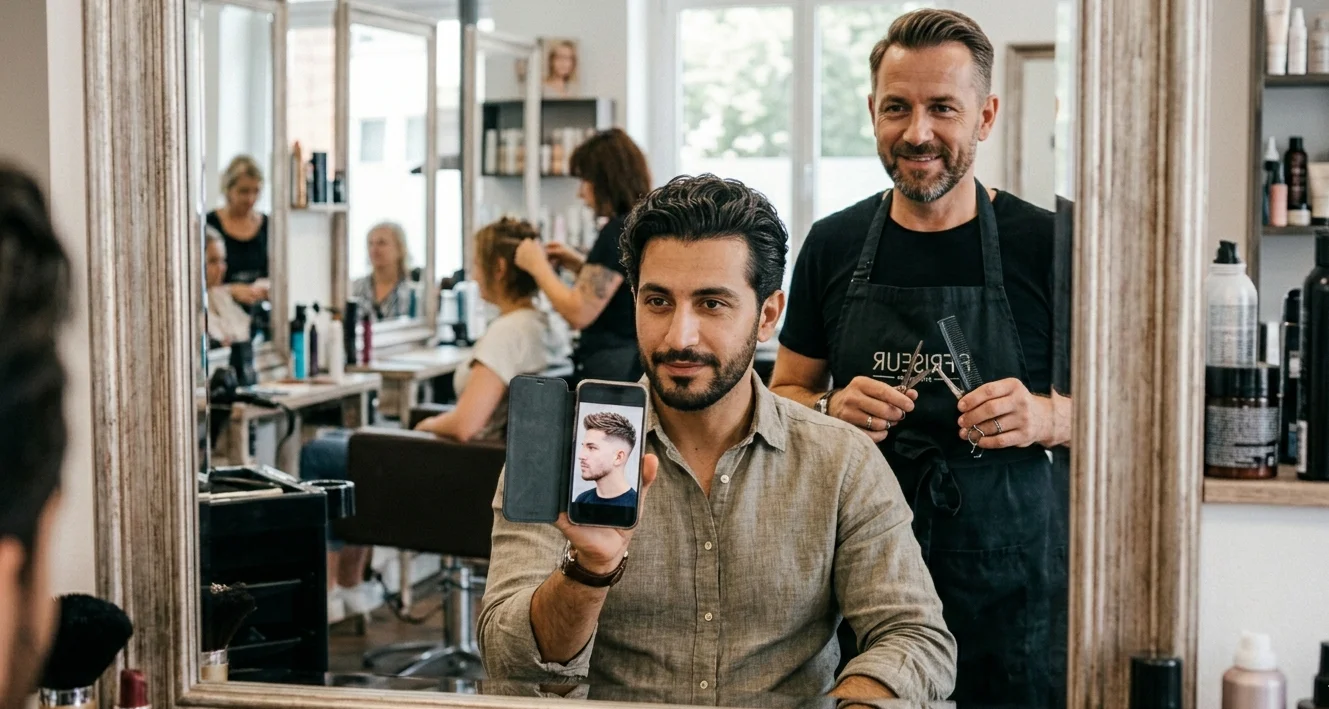
The single most effective tool at any hairdresser, in any language, in any country: a photo on your phone. "Können Sie mir so einen Schnitt machen?" — "Can you cut it like this?" No vocabulary required. Use Google Images, Pinterest, or Instagram. Show it confidently and let the stylist confirm they can do it.
05
Length — talking in centimetres and grades
Germany uses centimetres for hair length — not inches. And clipper grades (Aufsätze) follow the standard international system. Here's what to ask for and what it means.
1
Aufsatz
3mm — very close crop
2
Aufsatz
6mm — short but visible
3
Aufsatz
9mm — classic short side
4
Aufsatz
12mm — medium crop
6
Aufsatz
18mm — longer crop
| What you want | What to say in German |
|---|
| Grade 2 on the sides | An den Seiten mit Aufsatz zwei bitte. |
| Grade 3 sides, grade 4 on top | Seiten mit Drei, oben mit Vier bitte. |
| 2cm off the top | Oben zwei Zentimeter kürzen bitte. |
| 3cm off the length overall | Insgesamt etwa drei Zentimeter abnehmen bitte. |
| Just the ends — 1cm | Nur die Spitzen — einen Zentimeter bitte. |
| Half the length | Ungefähr die Hälfte der Länge abnehmen bitte. |
| Leave the length, just shape it | Länge behalten — nur in Form bringen bitte. |
When in doubt about how much to take off, hold your fingers apart to show the length — "etwa so viel" (about this much). Germans will understand immediately. Physical gestures are completely acceptable and widely used, even by German speakers themselves.
06
Hair zones and technique vocabulary
The more precisely you can describe which part of your head you're talking about, the better the result. Here are the zones and the key technical terms:
oben / der Oberkopf
on top / the top of the head
der Hinterkopf
the back of the head
der Nacken / das Genick
the neckline / nape of the neck
der Pony / die Stirn
the fringe / the forehead
die Spitzen
the ends / tips
der Wirbel
the crown / cowlick
Common style names — with their German descriptions
Undercut
Undercut / Hinterschnitt
Oben lang, Seiten und Hinterkopf kurz rasiert oder sehr kurz. Often with a hard part (Scheitel rasiert).
Fade
Fade / Übergangsschnitt
A gradient from very short at the sides up to longer on top. "Sanfter Übergang" = soft fade. "Harter Übergang" = skin fade.
Crew Cut
Kurzhaarschnitt / Crew Cut
Uniform short all over, slightly longer on top. "Gleichmäßig kurz, oben minimal länger."
Bob
Bob-Schnitt
Jaw-length, blunt cut all around. "Stumpf geschnitten, auf Kinnlänge."
Layered Cut
Stufenschnitt / gestufte Haare
Multiple lengths creating movement. "Ich möchte Stufen für mehr Volumen."
Side Part
Seitenscheitel
"Ich trage einen Scheitel links / rechts." (I part my hair left / right.)
07
Full dialogue examples — real conversations
Scenario A: The straightforward men's cut
Ein typischer Herrenhaarschnitt
Barber
So — wie soll's werden heute?
So — what are we doing today?
You
Ich hätte gerne oben etwa zwei Zentimeter kürzer. An den Seiten und am Hinterkopf mit der Maschine — Aufsatz drei. Und am Nacken bitte sauber ausrasieren.
I'd like about two centimetres shorter on top. Clippers on the sides and back — grade three. And please shave the neckline clean.
Barber
Möchten Sie einen weichen oder einen harten Übergang zwischen oben und den Seiten?
Would you like a soft or a hard transition between the top and the sides?
You
Weich bitte — ein sanfter Übergang.
Soft please — a gentle blend.
Barber
Und den Scheitel — links, rechts, oder keinen?
And a parting — left, right, or none?
You
Links bitte.
Left please.
Barber
Möchten Sie auch den Bart trimmen lassen?
Would you also like the beard trimmed?
You
Ja gerne, nur etwas in Form bringen.
Yes please, just tidy it up a bit.
Scenario B: Women's appointment at a salon
Frauentermin im Salon
Stylist
Was hätten Sie heute gerne?
What would you like today?
You
Ich möchte die Spitzen schneiden lassen — ungefähr drei bis vier Zentimeter. Die Länge und die Form sollen erhalten bleiben. Nur ein bisschen frischer machen.
I'd like the ends trimmed — about three to four centimetres. The length and the shape should stay the same. Just freshen it up a bit.
Stylist
Möchten Sie, dass wir die Haare zuerst waschen?
Would you like us to wash your hair first?
You
Ja gerne. Und könnten Sie sie danach auch föhnen?
Yes please. And could you also blow-dry them afterwards?
Stylist
Selbstverständlich. Möchten Sie eine Pflegekur dazu?
Of course. Would you like a conditioning treatment as well?
You
Was kostet das?
How much does that cost?
Stylist
Die Pflegekur kostet neun Euro extra.
The treatment costs nine euros extra.
You
Nein danke, nur den Schnitt und Föhnen reicht mir.
No thank you, just the cut and blow-dry is enough for me.
Mid-cut check-ins — what the barber will say
| They will say | What they're asking |
|---|
| Wie gefällt Ihnen das so? | How do you like it so far? |
| Passt die Länge so? | Is the length right like that? |
| Soll ich noch mehr wegnehmen? | Should I take off more? |
| Ist es Ihnen hier kurz genug? | Is it short enough here for you? |
| Gefällt Ihnen der Übergang so? | Do you like the transition/blend like that? |
| Soll ich die Ohren freilassen oder bedecken? | Should I leave the ears uncovered or covered? |
| Wünschen Sie noch etwas anderes? | Is there anything else you'd like? |
08
Beard and shaving vocabulary
der Vollbart
full beard
"Ich möchte meinen Vollbart trimmen lassen."
der Dreitagebart
stubble (literally: three-day beard)
Short, designer stubble.
der Schnurrbart
moustache
"Können Sie den Schnurrbart kürzen?"
der Backenbart / Koteletten
sideburns
"Die Koteletten kürzen bitte."
die Konturlinie / Konturen
the beard line / contour
"Die Konturen bitte sauber ziehen."
rasieren
to shave
"Die Wangen bitte rasieren."
die Nassrasur
wet shave
Traditional razor shave — offered at upmarket barbershops.
das Rasiermesser
straight razor
Used for Nassrasur and neckline finishing.
Beard trim — Barttrimmen
You
Könnten Sie auch meinen Bart trimmen? Nur etwas kürzen und die Konturen sauber ziehen.
Could you also trim my beard? Just shorten it a bit and clean up the lines.
Barber
Wie kurz soll der Bart werden?
How short should the beard be?
You
Etwa so lang — fünf bis sechs Millimeter. Und die Wangen bitte rasieren.
About this long — five to six millimetres. And please shave the cheeks clean.
You
Die Konturen bitte scharf — unterm Kinn und an den Wangen klare Linien.
Please make the lines sharp — clean lines under the chin and on the cheeks.
09
Colour, highlights and treatments
Colour appointments are longer, more expensive, and require more specific vocabulary. If your German is still developing, book a consultation first ("Beratungsgespräch") and bring photos. But if you want to try in German, here is the vocabulary you need.
| German | English |
|---|
| Ich möchte meine Haare färben lassen. | I'd like to have my hair coloured. |
| Ich möchte meine grauen Haare abdecken. | I'd like to cover my grey hair. |
| Ich hätte gerne Strähnchen / Highlights. | I'd like highlights. |
| Ich möchte etwas Helleres / Dunkleres. | I'd like something lighter / darker. |
| Können Sie mir eine Farbe empfehlen, die zu meinem Teint passt? | Can you recommend a colour that suits my complexion? |
| Ich möchte eine Tönung — keine dauerhafte Farbe. | I'd like a toner — not permanent colour. |
| Wie lange hält die Farbe? | How long does the colour last? |
| Gibt es eine Pflegekur für trockene / geschädigte Haare? | Is there a treatment for dry / damaged hair? |
| Kann ich vorher eine Farbberatung haben? | Can I have a colour consultation first? |
| Was kostet das ungefähr alles zusammen? | How much does it all cost roughly in total? |
Cultural note — colour prices
Colour prices in German salons are rarely listed on the menu — they depend on your hair length and the technique. Always ask "Was kostet das ungefähr?" before you agree. A full colour appointment at a mid-range salon typically costs €60–120+. Highlights can run €80–200+ depending on the technique and hair length.
10
If it's going wrong — the bravest section
It happens. The cut is too short, too long in one spot, not what you imagined. Speaking up mid-cut feels uncomfortable — but a good barber or stylist genuinely wants to get it right. Here is how to intervene, clearly and politely, without making it awkward.
Stopping and redirecting — Korrektur während des Schnitts
You
Entschuldigung — könnten Sie kurz stoppen? Ich glaube, oben ist es etwas zu kurz geworden.
Excuse me — could you stop for a moment? I think it's become a little too short on top.
You
Darf ich kurz schauen? Ich glaube, die Seiten könnten noch etwas kürzer sein.
May I have a quick look? I think the sides could be a little shorter still.
You
Hier hinten — könnten Sie das noch etwas angleichen? Es sieht etwas ungleichmäßig aus.
Here at the back — could you even that out a bit? It looks a little uneven.
You
Ich habe mir das eigentlich etwas anders vorgestellt — oben sollte mehr Länge bleiben. Ist das noch zu retten?
I actually had something a little different in mind — more length should have stayed on top. Is it still salvageable?
Asking to check during the cut
You
Darf ich kurz in den Spiegel schauen?
May I have a quick look in the mirror?
You
Können Sie mir bitte zeigen, wie es hinten aussieht?
Could you please show me how it looks at the back?
The barber will use a hand mirror to show you the back. This is completely standard — ask for it at the end if they don't offer it automatically.
At the end — your final checks before you pay
| German | English |
|---|
| Könnten Sie mir den Hinterkopf zeigen? | Could you show me the back of the head? |
| Hier an der Seite — könnten Sie das noch etwas nacharbeiten? | Here on the side — could you refine that a little? |
| Sieht gut aus — danke sehr. | Looks good — thank you very much. |
| Ich bin sehr zufrieden, danke. | I'm very happy with it, thank you. |
A barber who has done a good job genuinely wants to hear it. "Sieht super aus!" (Looks great!) or "Bin sehr zufrieden" (Very happy with it) costs nothing and makes the interaction warm. German service culture is not effusive — but a sincere compliment is always welcomed.
11
Paying and tipping — the cultural part
Payment in German barbershops and salons is usually cash or card — though some smaller traditional barbers are still cash-only. Always check when in doubt: "Kann ich mit Karte zahlen?"
Paying — Bezahlen
Barber
Das macht [Betrag] Euro bitte.
That's [amount] euros please.
You
Kann ich mit Karte zahlen?
Can I pay by card?
You
Stimmt so.
Keep the change.
The most useful German phrase for any service transaction. Say it when handing over cash and you don't want change back — it includes your tip.
You
Machen Sie [Betrag] daraus bitte.
Please make it [amount]. (When you want to specify the rounded-up total)
Example: bill is €24, you say "Machen Sie fünfundzwanzig daraus" — make it €25.
Tipping culture in Germany
Tipping at German hair salons is normal and expected, but the amount is modest by international standards. A typical tip is 10–15% of the bill, or simply rounding up to the nearest round number. On a €28 haircut, €30 (keeping €2) is standard. On a €55 colour appointment, €60 is generous. You can hand the tip directly to the stylist or include it in the payment by saying "Stimmt so" or "Machen Sie [X] daraus." Tipping is appreciated — not tipping is noticed.
The phrase that handles everything
"Stimmt so" is one of the most useful phrases in all of German daily life — and it works far beyond the barbershop. At any café, taxi, restaurant, or service transaction where you're paying cash and want the barista, driver, or stylist to keep the change as a tip, "Stimmt so" is all you need. Two words. Infinite use.
12
Your complete barbershop survival card
Surviving Germany — Friseur Phrase Card
Ich möchte einen Haarschnitt.
I'd like a haircut.
Haben Sie noch Zeit / einen Termin für heute?
Do you still have time / an appointment for today?
Oben [X] Zentimeter kürzer bitte.
Please [X] centimetres shorter on top.
An den Seiten mit Aufsatz [Nummer] bitte.
Clippers on the sides, grade [number] please.
Nur die Spitzen — die Länge soll bleiben.
Just the ends — the length should stay.
Nur mit der Schere bitte — keine Maschine.
Scissors only please — no clippers.
Weicher / harter Übergang an den Seiten.
Soft / hard blend on the sides.
Am Nacken bitte rasieren / sauber machen.
Please shave / clean up the neckline.
Die Form behalten — nur etwas frischer machen.
Keep the shape — just freshen it up.
Können Sie mir den Hinterkopf zeigen?
Could you show me the back?
Hier könnte es noch etwas kürzer / gleichmäßiger sein.
This could be a little shorter / more even here.
Auch den Bart bitte trimmen — Konturen sauber ziehen.
Also please trim the beard — clean up the lines.
Kann ich mit Karte zahlen?
Can I pay by card?
Stimmt so.
Keep the change. (Your universal tipping phrase)
Vielen Dank — bin sehr zufrieden!
Thank you very much — very happy with it!
One last thought: the barbershop is actually one of the best places to practise your German in a low-stakes, friendly setting. The conversation is short, the topic is concrete and visual, and good barbers are naturally sociable. If your barber asks "Wie gefällt's Ihnen in Deutschland?" — "How do you like it in Germany?" — that's not small talk. That's an invitation. Take it.
Want to practise a full barbershop dialogue in German before your next appointment? Deutsch-Assistent can run through the whole conversation with you — from "Was darf es sein?" to "Stimmt so."
Practise Your Barbershop German →