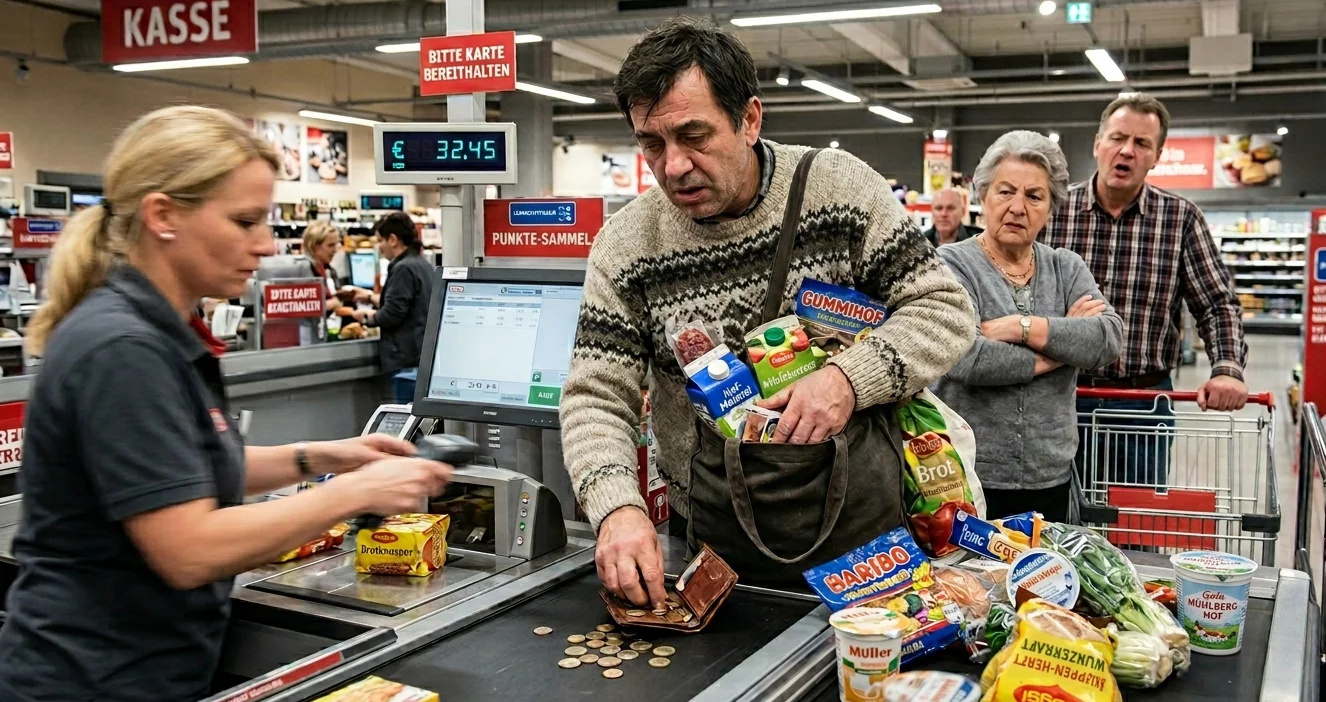
The German supermarket checkout is the most reliably stressful two minutes in immigrant daily life. The cashier is fast, the queue is watching, the card machine has opinions, and someone just asked you something you didn't understand. This guide prepares you for all of it — and for everything that happens before you even reach the till.
You go to the supermarket several times a week. That makes it the single most frequent German-language situation in most people's lives — and yet it's also the one people feel least prepared for. The speed, the rituals, the unwritten rules. The fact that Germans bag their own shopping at a pace that borders on competitive sport. The Pfand system. The produce scale. The loyalty card question that catches you off guard every single time.
This guide covers it all. From the moment you walk through the sliding doors to the moment the receipt is in your hand.
Germany has a highly developed supermarket landscape with clear tiers. Knowing which shop is which saves time, money, and occasional confusion about why a store looks so empty.
Very limited range, no frills, exceptional value. Items move fast and stock changes weekly — especially the middle aisle "Sonderangebote."
Similar to Aldi but slightly wider range. Strong on fresh produce and bakery. The rotating weekly specials are famous.
Regional discount chains. More convenience-store feel. Often in residential neighbourhoods.
The most ubiquitous full-service supermarket. Good range, reliable quality, Payback loyalty card. Often open on Sundays at petrol stations.
Germany's largest supermarket by revenue. Franchised — quality varies by location. DeutschlandCard loyalty programme.
Larger stores, wider range including non-food. Good for a big weekly shop.
Very large format — food plus electronics, clothing, household. Less common but useful for a full weekly shop.
Strong focus on regional and organic products. Central Germany primarily.
Dedicated organic food shops. Pricier but wide organic range. Popular in larger cities.
Almost all German supermarkets are closed on Sundays. This is protected by the Ladenschlussgesetz (shop closing law) and taken seriously. Exceptions: supermarkets at train stations and airports are usually open. Petrol station shops (often Rewe or Esso shops) are open. If you run out of something on Sunday, your options are limited — plan your weekly shop with this in mind.
German food labels follow EU regulations and are detailed — sometimes more than you'd expect. Here are the key terms that tell you what something actually is.
Certified organic. EU Bio logo (green leaf) is the minimum standard. German Bio is often held to a higher standard.
Fair trade certified — especially for coffee, chocolate, and bananas. Widely available in German supermarkets.
Best-before date — "mindestens haltbar bis." Food is often safe and good well past this date. Not the same as an expiry date.
Use-by date — for fresh meat, fish, and dairy. This one is strict. Do not ignore it.
Ingredients list — always listed in descending order by weight. Allergens are usually bolded.
Nutritional information — per 100g and per portion. Includes Energie (kcal), Fett (fat), Kohlenhydrate (carbohydrates), Eiweiß (protein).
No additives / no preservatives. Common claim on German food packaging.
Contains gluten / may contain traces of nuts. Allergen labelling is mandatory in Germany.
Deposit bottle. 25 cents for most glass and plastic bottles, 15 cents for some smaller containers. Return for refund.
Regional product — grown or produced locally. Supermarkets increasingly highlight these, especially Edeka and Rewe.
Drained weight / net weight. For tinned goods — the weight without the liquid.
Store refrigerated / frozen product. Important storage instructions — check before buying perishables.
| German label | What it actually means |
|---|---|
| Weizenmehl Type 405 | Plain white flour — the most common. Type 550 is slightly stronger, good for bread. |
| Vollkorn | Wholegrain — applies to bread, pasta, rice, flour |
| Mager | Low-fat (literally: lean). "Magermilch" = skimmed milk |
| Vollmilch | Full-fat / whole milk |
| Haltbare Milch / H-Milch | UHT / long-life milk — does not need refrigerating until opened |
| Quark | A fresh dairy product — somewhere between yoghurt and cream cheese. Not cheese, not yoghurt. |
| Skyr | Icelandic-style strained dairy — high protein, widely available and popular |
| Hähnchen vs. Huhn | Hähnchen = young chicken (for roasting). Huhn = hen / general chicken. |
| Rührei vs. Spiegelei | Scrambled eggs vs. fried eggs. Relevant at bakery counters and breakfast spots. |
In most German supermarkets, loose fruit and vegetables must be weighed and labelled before you reach the checkout. There are usually digital scales in the produce section. This step is invisible until the cashier stops and asks you to go back — which is mortifying the first time it happens.
Place your item on the scale. Find the PLU number on the shelf label — usually a 4-digit code. Type it into the scale's keypad. The scale prints a sticky barcode label. Stick it on the bag or directly on the item. At checkout the cashier scans this label. Different stores have slightly different systems — some have touchscreens with photos, some have number keypads. If unsure, ask: "Wie benutze ich die Waage?"
The German supermarket checkout is a well-choreographed sequence that regular shoppers complete almost unconsciously. As a newcomer, seeing the steps laid out removes the anxiety of not knowing what comes next.
Look for the shortest queue. Queues at discount supermarkets (Aldi, Lidl) move very fast. There is an implied social contract: do not jump queues. If you need to leave briefly, leave something in your trolley to mark your place.
This is non-negotiable German checkout etiquette. As soon as you start placing your items on the belt, put a Trenner (divider) behind them. Not doing so is considered rude to the person behind you.
"Hier ist der Trenner." — Here is the divider bar. (Said while handing it to the next customer if they seem confused)Germans arrange their items on the belt strategically — heavy items first, cold items together, fragile items last. You don't need to do this perfectly, but placing items quickly and not fumbling is appreciated.
The cashier will almost certainly ask. Have your Payback card, DeutschlandCard, or app open before you reach the front. This saves time and earns points.
"Haben Sie eine Kundenkarte?" — Do you have a loyalty card?This is the part that shocks newcomers most. German cashiers scan items at remarkable speed. You are expected to pack into your own bags simultaneously. Do not wait for all items to be scanned before you start packing. Start immediately. If you fall behind, do not panic — step aside to a packing counter if available, or pack quickly at the end. The cashier will wait briefly but the pressure is real.
"Ich brauche eine Tüte bitte." — I need a bag please.Have your payment method ready before the total appears. See section 09 for full payment details.
"Das macht X Euro." — That comes to X euros.Since 2020, German supermarkets are legally required to offer a receipt but you can decline it. The cashier may ask.
"Möchten Sie den Bon?" — "Nein danke." / "Ja bitte."The single most important thing to know about the German supermarket checkout: speed is a social value. Germans do not dawdle at the till. Having your loyalty card ready, your payment method accessible, and your bag open before you reach the cashier is not just efficient — it is considerate. The queue behind you notices everything.
The checkout is where the language pressure peaks. Here is every common thing a German cashier says, translated and explained so nothing catches you off guard.
| Cashier says | What they mean / how to respond |
|---|---|
| Haben Sie eine Kundenkarte? | Do you have a loyalty card? — "Ja, hier." / "Nein, leider nicht." / "Ja, in der App." |
| Payback? / DeutschlandCard? | Shortened version of the above — same responses. |
| Brauchen Sie eine Tüte? | Do you need a bag? — "Ja bitte, eine große." / "Nein danke, ich habe eine." |
| Haben Sie Kleingeld? | Do you have change / small coins? — They want to avoid breaking a large note. "Ja, ich habe [Betrag]." / "Nein, leider nicht." |
| Das macht [Betrag] Euro. | That comes to [amount] euros. — Your cue to pay. |
| Möchten Sie den Bon? | Would you like the receipt? — "Ja bitte." / "Nein danke." |
| Haben Sie die Ware schon abgewogen? | Have you already weighed the produce? — If no: "Nein, tut mir leid — wo ist die Waage?" |
| Das scannt nicht. / Ich bekomme kein Signal. | This isn't scanning. They'll try again or call a colleague. Just wait. |
| Dieser Artikel ist nicht im System. | This item isn't in the system — usually a price check is needed. Wait calmly. |
| Zahlen Sie bar oder mit Karte? | Are you paying cash or by card? — "Mit Karte." / "Bar." |
| PIN bitte / Bitte bestätigen. | PIN please / Please confirm. — Enter your PIN on the card reader. |
| Das geht leider nicht. / Die Karte wird abgelehnt. | That doesn't work unfortunately. / The card is being declined. — Try another card or pay cash. |
| Einen schönen Tag noch! | Have a nice day! — "Danke, Ihnen auch!" |
"Entschuldigung, ich verstehe nicht ganz — können Sie das bitte wiederholen?" — "Excuse me, I don't quite understand — could you please repeat that?" Said calmly, this phrase pauses everything and resets the conversation. Cashiers deal with language barriers regularly, especially in cities. They will slow down.
Germany has historically been a cash-dominant country, but card payment has grown enormously. Both are accepted almost everywhere now — but there are still supermarkets, market stalls, and small shops that are cash-only.
| German | English |
|---|---|
| Mit Karte zahlen | Pay by card |
| Bar zahlen | Pay cash |
| Kontaktlos zahlen | Pay contactless |
| Mit dem Handy / per Apple Pay zahlen | Pay with phone / Apple Pay |
| Das Wechselgeld | The change |
| Der Geldschein / die Münze | Banknote / coin |
| Die Karte wird abgelehnt | The card is being declined |
| Bitte PIN eingeben | Please enter your PIN |
| Zahlung bestätigen | Confirm payment |
| Belastung erfolgreich | Payment successful |
Even as card payment grows, many Germans still prefer cash for everyday purchases. Market stalls, small bakeries, street food, and some discount supermarkets may still be cash-only. Always have some cash on you. The €20 and €50 notes are the most practical denominations — €100 notes are sometimes refused at small shops.
The Pfand (deposit) system is one of Germany's most successful environmental initiatives — and one of the most confusing things for newcomers. Here is everything you need to know.
When you buy a drink in a Pfandflasche (deposit bottle) or Pfanddose (deposit can), you pay an additional deposit on top of the drink price — usually 25 cents per bottle or can, sometimes 15 cents for smaller containers. When you return the empty bottle or can to a supermarket's Pfandrückgabe machine, you get the deposit back as a Pfandbon (voucher) which you can use in that store.
| Pfand vocabulary | Meaning |
|---|---|
| die Pfandflasche | Deposit bottle — look for "Pfand" or the recycle symbol with a value on the label |
| die Pfanddose | Deposit can — 25 cents each |
| die Pfandrückgabe | The bottle return machine / area |
| der Pfandbon | The voucher you receive after returning bottles |
| einlösen | To redeem (a voucher) |
| Einwegpfand / Mehrwegpfand | Single-use deposit / refillable deposit — different values |
| Kein Pfand / pfandfrei | No deposit — on Tetra Pak, juice cartons, wine bottles |
Not all bottles have Pfand. Wine bottles, spirits, Tetra Pak cartons, and many imported products have no deposit. Check the label before assuming. The Pfand symbol or the text "Pfand 0,25 €" must appear on the label for the machine to accept it.
German consumer law is strong. You have the right to return items that are defective. For non-defective items, return policies vary by store — but most major supermarkets are reasonable about returns.
Germany's two main loyalty programmes are Payback (used at Rewe, dm, Aral, and others) and DeutschlandCard (used at Edeka and Netto). Both are free to join, work via card or app, and earn points on purchases that eventually convert to vouchers.
If you shop regularly at Rewe or dm, Payback is worth having — it is free and the vouchers add up meaningfully over a year of regular shopping. Download the app and use it digitally — you don't need to carry a physical card. For Edeka shoppers, DeutschlandCard works the same way. Both also offer weekly bonus point deals that significantly accelerate your earnings.
One final thought: the German supermarket checkout is, in a strange way, a microcosm of German culture. There is a right way to do things, an implicit code of conduct, and a quiet expectation that everyone will follow it. Once you know the rhythm — divider bar, pack quickly, payment ready, "Stimmt so" or PIN — it stops being stressful and becomes second nature. And on the day you realise the cashier at your local Aldi has started recognising you and nodding hello, you'll know you've genuinely settled in.
Want to practise a supermarket conversation — from produce aisle to checkout — in German before your next shop? Deutsch-Assistent walks you through it step by step.
Practise Your Supermarket German →