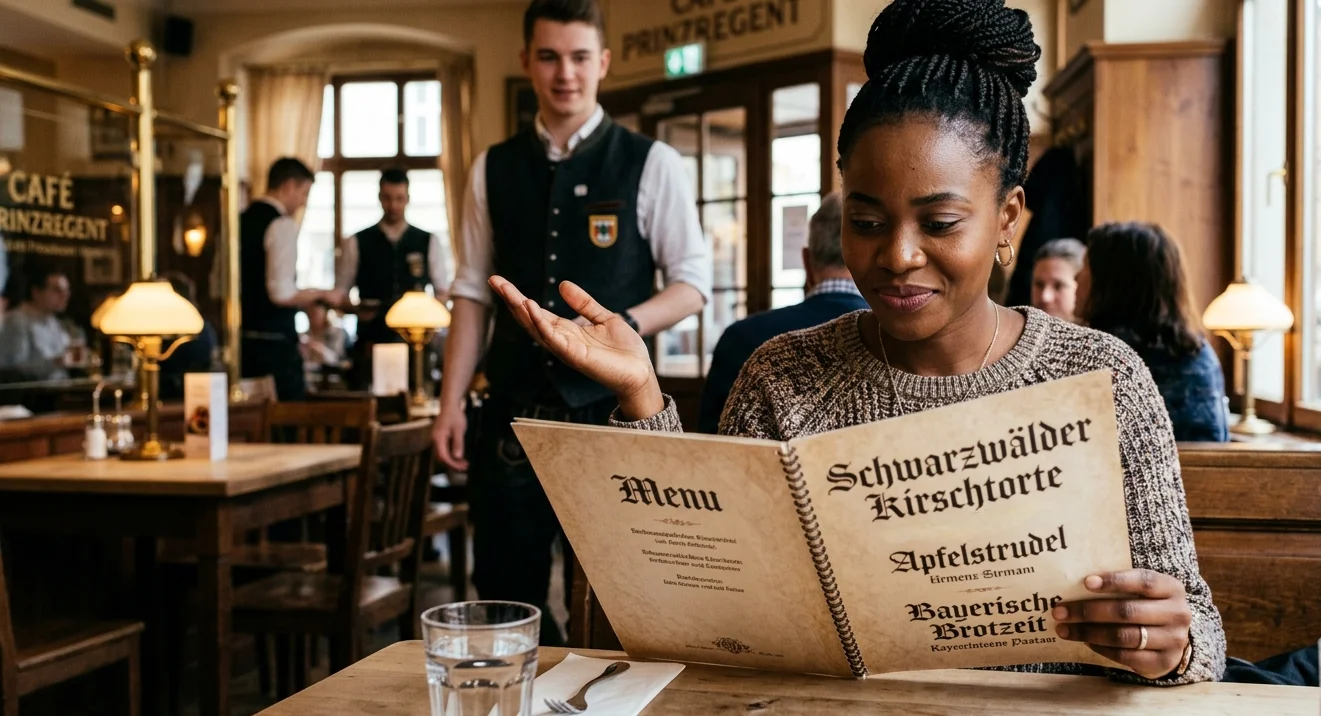
Surviving Germany — #07
Everyday Life
At the Café and Restaurant in Germany: Order, Ask, Pay — Like You've Always Done It
Reading time: ~16 minutes · Café, restaurant, Biergarten, Kneipe — all covered · All levels welcome
Eating out in Germany should be one of life's pleasures — not a source of anxiety. But between the formal table service, the bill-splitting customs, the 30-second rule at the door, and that one phrase every waiter waits to hear at the end, there is a distinct way of doing things. This guide makes you fluent in all of it.
Germany has a genuine café and restaurant culture. From the neighbourhood Café with its thick Filterkaffee and slice of Kuchen, to the bustling Biergarten in summer, to the white-tablecloth Gasthaus where lunch is a serious ritual — eating and drinking out is woven into daily life here. And yet for newcomers, what should be a relaxed experience can feel loaded with unspoken rules.
Why isn't the waiter coming? Do I have to tip? Can I ask for the bill whenever I want? What does "Stimmt so" actually mean? And what on earth is a "Radler"?
All of that — and more — is in this guide.
What's in this guide
- 01 Essential vocabulary
- 02 Types of German venues
- 03 Getting a table
- 04 The café — coffee & cake
- 05 Ordering food
- 06 Drinks — the full guide
- 07 Dietary needs
- 08 During the meal
- 09 Reading the menu
- 10 Paying the bill
- 11 Tipping culture
- 12 The Biergarten
- 13 Full survival card
01
Essential vocabulary — the language of eating out
die Speisekarte / die Karte
the menu
"Könnten wir bitte die Karte haben?"
die Tageskarte
the daily specials menu
Often the best value — ask "Was ist heute die Tageskarte?"
die Vorspeise
starter / appetiser
Also: Appetithappen (amuse-bouche)
das Hauptgericht / die Hauptspeise
main course
The centrepiece of the meal.
die Nachspeise / das Dessert
dessert
"Was hätten Sie gerne als Nachspeise?"
das Gericht / die Speise
dish / food item
General term for a dish on the menu.
die Beilage
side dish / accompaniment
Potatoes, salad, vegetables — often listed separately.
die Kellnerin / der Kellner
waitress / waiter
Also: Bedienung (service person). To call them: "Entschuldigung!"
bestellen
to order
"Wir möchten gerne bestellen." / "Darf ich bestellen?"
die Rechnung
the bill / check
"Die Rechnung bitte." — four of the most useful words in Germany.
getrennt / zusammen
separately / together (for the bill)
The eternal question. "Zahlen Sie zusammen oder getrennt?"
das Trinkgeld
tip / gratuity
Literally: "drinking money." Usually 10–15%.
Stimmt so.
Keep the change.
The most important phrase in this entire guide. See section 10.
reservieren
to reserve / book
"Ich habe einen Tisch reserviert." / "Haben Sie noch Platz?"
glutenfrei / laktosefrei / vegan
gluten-free / lactose-free / vegan
All widely understood in modern German restaurants.
die Allergie / die Unverträglichkeit
allergy / intolerance
"Ich habe eine Allergie gegen Nüsse."
das Leitungswasser
tap water
Not always offered — ask specifically if you want it.
mit / ohne Kohlensäure
still / sparkling (water)
"Ein Wasser ohne Kohlensäure bitte."
das Tagesgericht
dish of the day
Usually great value — a full meal at a fixed price.
der Strauß / das Sonderangebot
special offer
"Was empfehlen Sie heute?"
02
Know your venue — types of German eating and drinking places
Germany has a richer vocabulary for places to eat and drink than most countries. Knowing what kind of place you're in helps you understand the level of service, the format, and the unwritten rules that apply.
| Venue type | What it is and how it works |
|---|
| das Café | Coffee and cake culture. Table service is standard. You sit down, a server comes to you. Staying for hours over one coffee is completely normal and never frowned upon. |
| das Restaurant | Full sit-down dining. You wait to be seated or seat yourself — watch for a sign or staff gesture. Menus are brought to you. Bill is brought when you ask for it. |
| die Gaststätte / das Gasthaus | Traditional German pub-restaurant. More rustic, often family-run. Very regional food. Communal seating at large tables is normal — strangers sit together. |
| der Biergarten | Open-air beer garden, typically attached to a brewery. Often self-service (Selbstbedienung) for drinks — you order and collect at the counter. Food may be table service or not. Communal benches. |
| die Kneipe | A neighbourhood bar / pub. Usually standing or bar seating. You order at the bar. No table service expected. Cash often preferred. |
| das Bistro / der Imbiss | Quick service, often counter ordering. Pay when you order. No tipping expected. Popular for Döner, Currywurst, and quick lunches. |
| die Bäckerei / Bäckereicafé | Bakery with seating. Order at the counter, take a number or find a seat. Counter service — not table service. You clear your own tray. |
| das Brauhaus | Brewery restaurant. Beer brewed on-site. Kellner (waiter) often brings beer unrequested — it is your right to decline. Chalk on the coaster tracks how many you've had. |
Cultural note — the 30-second rule
In a German restaurant, you do not seat yourself without being invited to. Stand at the entrance for a moment and make eye contact with a server or host. If no one comes within about 30 seconds, it's fine to walk in and find your own table. In busy Gaststätten and Biergärten, seating yourself is the norm. Reading the room is key — if it looks like a formal restaurant, wait. If it looks like a Kneipe, sit.
03
Getting a table — arriving and being seated
Arriving without a reservation — Ohne Reservierung
You
Guten Abend. Haben Sie noch einen Tisch für zwei Personen?
Good evening. Do you still have a table for two?
Host
Ja, natürlich. Kommen Sie bitte mit.
Yes, of course. Please follow me.
Host
Haben Sie eine Reservierung?
Do you have a reservation?
You
Nein, leider nicht — haben Sie noch Platz?
No, unfortunately not — do you still have room?
You
Dürfen wir uns dazusetzen?
May we sit here? / May we join you?
Standard phrase when joining strangers at a communal table — perfectly normal in Biergärten and Gaststätten.
With a reservation — Mit Reservierung
You
Guten Abend, wir haben einen Tisch reserviert. Auf den Namen [Name].
Good evening, we've reserved a table. Under the name [Name].
You
Wäre es möglich, einen Tisch drinnen / draußen zu bekommen?
Would it be possible to have a table inside / outside?
You
Wir sind leider nur zu zweit — die anderen kommen später nach.
Unfortunately there are only two of us — the others are coming later.
Asking about the seating situation
| German | English |
|---|
| Wie lange ist die Wartezeit ungefähr? | How long is the wait roughly? |
| Können wir auf der Terrasse / im Garten sitzen? | Can we sit on the terrace / in the garden? |
| Gibt es einen Platz in der Nähe des Fensters? | Is there a spot near the window? |
| Wäre ein ruhigerer Tisch möglich? | Would a quieter table be possible? |
| Ist der Platz noch frei? | Is this spot still free? |
04
The German café — coffee, cake and the art of lingering
The German Café is its own institution. It runs on Filterkaffee, elaborate cakes, and the deeply held belief that a table is yours for as long as you want it. No one will rush you. No one will bring the bill without being asked. This is considered respectful — not neglectful.
Coffee — the full German menu decoded
Filterkaffee
Filtered / drip coffee
The classic. Often comes in a pot.
Espresso
Espresso
Single shot. "Einen Espresso bitte."
Verlängerter / Americano
Americano / long espresso
Espresso with hot water. "Ein Verlängerter."
Cappuccino
Cappuccino
Universal. Sometimes served with cocoa powder on top.
Latte Macchiato
Latte macchiato
Tall glass, layered. Very popular in Germany.
Kaffee Latte / Milchkaffee
Flat white / café au lait
Less formal. Often in a bowl in traditional cafés.
Kleiner / Großer Brauner
Small / large coffee with a dash of milk
Austrian term, used in some German cafés.
Eiskaffee
Iced coffee
NOT iced — it's coffee poured over vanilla ice cream. A German summer classic.
Tee / Kräutertee
Tea / herbal tea
Usually comes with honey separately.
Ordering coffee and cake — Kaffee und Kuchen bestellen
Barista
Was darf es sein?
What would you like?
You
Einen Cappuccino und ein Stück Käsekuchen bitte.
A cappuccino and a slice of cheesecake please.
Barista
Mit Sahne?
With cream?
You
Ja bitte. / Nein danke, ohne Sahne.
Yes please. / No thank you, without cream.
You
Was haben Sie heute für Kuchen?
What cakes do you have today?
In traditional cafés, the cakes on offer change daily. Always worth asking.
You
Ich nehme den Apfelstrudel bitte — ist er hausgemacht?
I'll have the apple strudel please — is it homemade?
You
Könnten Sie mir noch einen Kaffee bringen?
Could you bring me another coffee?
Cultural note — Kaffee und Kuchen
Kaffee und Kuchen (coffee and cake) is a genuine German social ritual — typically on Sunday afternoons between 3 and 5pm. It's not just a snack; it's a reason to gather. Arriving at a traditional café between 3 and 4pm on a Sunday and finding every table full is not unusual. Book ahead or arrive early.
05
Ordering food — the full restaurant experience
Full restaurant ordering sequence — Vollständige Bestellung
Waiter
Haben Sie schon gewählt?
Have you chosen yet?
You
Ja, wir möchten gerne bestellen.
Yes, we'd like to order.
You
Noch nicht ganz — könnten Sie noch einen Moment warten?
Not quite yet — could you wait just a moment?
Waiter
Was darf ich Ihnen bringen?
What may I bring you?
You
Ich nehme die Zwiebelsuppe als Vorspeise und das Schnitzel mit Bratkartoffeln als Hauptgericht.
I'll have the onion soup as a starter and the schnitzel with roast potatoes as a main.
You
Und für mich bitte die Pasta — aber ohne Parmesan, ich bin laktoseintolerant.
And for me the pasta please — but without Parmesan, I'm lactose intolerant.
Waiter
Und was möchten Sie trinken?
And what would you like to drink?
You
Ein Weizenbier bitte und ein Glas Weißwein — welchen Weißwein empfehlen Sie?
A wheat beer please and a glass of white wine — which white wine do you recommend?
Waiter
Soll ich die Vorspeise und das Hauptgericht direkt nacheinander bringen?
Should I bring the starter and main course directly one after the other?
You
Ja bitte. / Nein, bitte etwas Pause dazwischen.
Yes please. / No, please a bit of a gap in between.
Essential ordering phrases
| German | English |
|---|
| Ich nehme... / Ich hätte gerne... | I'll have... / I'd like... |
| Wir möchten gerne bestellen. | We'd like to order please. |
| Was empfehlen Sie heute? | What do you recommend today? |
| Was ist das Tagesgericht? | What is the dish of the day? |
| Ist das Gericht scharf / mild? | Is the dish spicy / mild? |
| Was ist in diesem Gericht drin? | What is in this dish? |
| Ohne [Zutat] bitte. | Without [ingredient] please. |
| Können Sie das Dressing separat servieren? | Can you serve the dressing separately? |
| Ich möchte noch eine Portion bitte. | I'd like another portion please. |
| Könnten Sie mein Gericht etwas wärmer bringen? | Could you bring my dish a little warmer? |
| Das war sehr lecker, danke. | That was very delicious, thank you. |
| Könnten wir bitte die Karte haben? | Could we have the menu please? |
Calling the waiter — the right way
In Germany, you do not snap your fingers, wave wildly, or call "Hey!" across the room. You make brief eye contact with the waiter and raise your hand slightly — or simply say "Entschuldigung" (excuse me) in a clear but not loud voice when they're nearby. Patience is expected. Servers will come to you when they are ready. Rushing them is considered rude.
06
Drinks — the full German guide
Germany has a deeply developed drink culture that goes far beyond beer. Knowing the vocabulary — and the cultural context — for what you're ordering saves you from surprises and opens the menu up considerably.
Beer — the essentials
Weizenbier / Weißbier
Wheat beer
Cloudy, yeasty, very popular in Bavaria.
Helles
Pale lager
The Munich standard. Light, crisp.
Pils / Pilsner
Pilsner
Drier and more bitter than a Helles.
Dunkles
Dark beer
Malty and rich. Not as heavy as stout.
Radler
Shandy (beer + lemonade)
Half beer, half Limonade. Very refreshing in summer.
Alkoholfreies Bier
Alcohol-free beer
"Ein Alkoholfreies bitte." Widely available and good quality in Germany.
Other drinks decoded
Schorle
Juice or wine mixed with sparkling water
"Apfelschorle" = apple juice + water. Hugely popular.
Apfelsaftschorle
Apple juice spritzer
The unofficial German national soft drink.
Weinschorle
Wine spritzer
White wine + sparkling water. Common in summer.
Spezi
Cola + orange soda mix
Particularly popular in Bavaria. Ask for it by name.
Leitungswasser
Tap water
Must be asked for specifically. Not always offered free.
Sekt
German sparkling wine / prosecco
Ubiquitous at celebrations. "Ein Glas Sekt bitte."
Ordering drinks — Getränke bestellen
You
Ein Weizenbier bitte — hell oder dunkel, egal.
A wheat beer please — light or dark, either is fine.
You
Haben Sie Wein offen? Was für einen Weißwein hätten Sie?
Do you have wine by the glass? What kinds of white wine do you have?
You
Ein Glas Wasser bitte — Leitungswasser ist mir recht.
A glass of water please — tap water is fine for me.
Asking specifically for Leitungswasser saves money. In some restaurants tap water is free; in others they may politely redirect you to bottled water. You can insist.
You
Eine Apfelschorle und einen Tee — welche Teesorten haben Sie?
An apple spritzer and a tea — which types of tea do you have?
You
Dürfte ich noch ein Bier bekommen? Dasselbe bitte.
Could I have another beer? The same one please.
Cultural note — the Brauhaus chalk system
In a traditional Brauhaus or Biergarten, your server may mark your coaster with a chalk stroke for each beer they bring. At the end you pay for the number of marks. Never erase or damage the coaster — even as a joke. This is their accounting system and tampering with it is considered genuinely rude.
07
Dietary needs — communicating clearly and confidently
Germany has become significantly more accommodating of dietary needs over the past decade. Vegetarian and vegan options are widely available in cities, and allergy awareness is taken seriously — partly because German food law requires restaurants to disclose major allergens. Here is how to communicate your needs clearly.
| Dietary need | How to say it |
|---|
| Vegetarian | Ich bin Vegetarier / Vegetarierin. Haben Sie vegetarische Gerichte? |
| Vegan | Ich lebe vegan. Welche Speisen auf der Karte sind vegan? |
| Gluten-free | Ich muss mich glutenfrei ernähren. Haben Sie glutenfreie Optionen? |
| Lactose intolerance | Ich bin laktoseintolerant. Enthält dieses Gericht Milchprodukte? |
| Nut allergy | Ich habe eine schwere Nussallergie. Enthält das Gericht Nüsse oder Spuren von Nüssen? |
| Shellfish allergy | Ich bin allergisch gegen Schalentiere. Ist das sicher für mich? |
| No pork | Ich esse kein Schweinefleisch. Welche Gerichte enthalten kein Schwein? |
| Halal | Haben Sie Halal-Fleisch? / Ich esse nur Halal. |
| No alcohol in cooking | Ich möchte kein Gericht, das mit Alkohol zubereitet wurde. |
Handling an allergy — Allergie ansprechen
You
Entschuldigung, ich habe eine Frage bevor ich bestelle — ich habe eine Erdnussallergie. Können Sie mir sagen, welche Gerichte sicher für mich sind?
Excuse me, I have a question before I order — I have a peanut allergy. Can you tell me which dishes are safe for me?
Waiter
Natürlich. Ich frage kurz in der Küche nach.
Of course. I'll just check with the kitchen quickly.
You
Können Sie das bitte in der Küche vermerken lassen? Es ist eine schwere Allergie.
Could you please make a note of it in the kitchen? It's a severe allergy.
The allergen list
By law, German restaurants must provide information about the 14 major allergens. If you see small numbers or letters next to menu items, they refer to an allergen key — usually listed at the bottom of the menu or on a separate card. Ask for the "Allergenliste" or "Zutatenliste" (ingredient list) if you need more detail. Servers are trained to help with this.
08
During the meal — everything between ordering and paying
Things the waiter will say — and what to reply
| They will say | What it means / how to respond |
|---|
| Guten Appetit! | Enjoy your meal! — Reply: "Danke, ebenfalls!" (Thanks, you too!) |
| Hat es Ihnen geschmeckt? | Did you enjoy it? — "Ja, sehr gut danke!" / "Es war ausgezeichnet." |
| Möchten Sie noch etwas? | Would you like anything else? — "Nein danke, nur die Rechnung bitte." or "Ja, noch ein Bier bitte." |
| Darf ich abräumen? | May I clear? — "Ja, bitte." / "Nein danke, ich bin noch nicht fertig." |
| Noch ein Wasser / Brot / Korb? | Another water / bread / basket? — "Ja gerne." / "Nein danke." |
| Zahlen Sie zusammen oder getrennt? | Paying together or separately? — See section 10. |
When something isn't right
Raising an issue — Etwas ansprechen
You
Entschuldigung — ich glaube, das ist nicht mein Gericht. Ich hatte das Schnitzel bestellt.
Excuse me — I think this isn't my dish. I ordered the schnitzel.
You
Entschuldigung, das Essen ist leider kalt. Könnten Sie es bitte aufwärmen lassen?
Excuse me, the food is unfortunately cold. Could you please have it warmed up?
You
Ich habe bestellt ohne Zwiebeln — leider sind welche im Gericht.
I ordered without onions — unfortunately there are some in the dish.
You
Wir warten jetzt schon etwa 40 Minuten auf unser Essen — könnten Sie nachfragen, wann es kommt?
We've been waiting about 40 minutes for our food now — could you ask when it's coming?
The German "complaint" style
Germans raise issues at restaurants directly but politely — there is no hedging or excessive apologising. "Das Fleisch ist leider nicht durch" (The meat is unfortunately not cooked through) said calmly to a waiter is not impolite — it is normal and expected. What is considered impolite is complaining loudly to other diners, being sarcastic, or making a scene. Say it clearly once, to the right person, and let them fix it.
09
Reading the menu — German food terms decoded
German menus can be wonderfully descriptive — and occasionally bewildering. Here are the most common terms that don't have an obvious English translation:
A phrase that unlocks any menu: "Was empfehlen Sie?" — "What do you recommend?" German waiters often have genuine opinions and love sharing them. Following their recommendation is also a cultural signal of trust — and it almost always results in a good meal.
10
Paying the bill — the most important section
Paying in Germany has its own ritual, its own vocabulary, and one phrase that every person living here needs to know by heart. This section exists to make sure you never feel lost at a German cashier again.
Stimmt so.
shtimmt zo
"Keep the change." — The phrase that handles every cash payment.
Say it when handing over cash. The waiter will not give change. Your tip is built in.
Asking for and paying the bill — Die Rechnung
You
Entschuldigung — die Rechnung bitte.
Excuse me — the bill please.
The standard way. No waving, no finger-clicking — just brief eye contact and this phrase.
Waiter
Zahlen Sie zusammen oder getrennt?
Are you paying together or separately?
You
Zusammen bitte.
Together please.
You
Getrennt bitte — ich zahle nur das Schnitzel und das Bier.
Separately please — I'm only paying for the schnitzel and the beer.
Waiter
Das macht 34,50 Euro bitte.
That comes to €34.50 please.
You
Stimmt so.
Keep the change. [Handing over €40 — tip of €5.50 built in]
You
Machen Sie 38 Euro daraus bitte.
Please make it €38. [Handing over €40, wanting €2 back]
You
Kann ich mit Karte zahlen?
Can I pay by card?
You
Ich glaube, da ist ein Fehler in der Rechnung — könnten Sie das bitte prüfen?
I think there might be a mistake in the bill — could you please check that?
The bill-splitting culture — Germany vs. everyone else
How Germany does it
Each person pays their own share
Splitting individually is completely normal, expected, and carries no awkwardness whatsoever. The waiter calculates each person's items separately. Germans have been doing this forever — it is not considered cheap or unfriendly.
Common expectation elsewhere
One person pays, others reimburse
In many cultures, one person picks up the tab and friends pay them back later. In Germany this is less common and creates confusion. The phrase "Zahlen Sie zusammen oder getrennt?" means Germany has built this difference directly into service.
In a group where people have ordered very different amounts — someone had starters and wine, someone had just a main — it is completely acceptable to say "Wir zahlen alle getrennt bitte" (We'll all pay separately please) without anyone raising an eyebrow. The waiter will handle it table by table, person by person.
11
Tipping culture — what is expected, what is generous
Tipping in Germany is expected but not mandatory, and the amounts are more modest than in the US or UK. Understanding the convention helps you tip appropriately without over- or under-doing it.
| Situation | Expected tip |
|---|
| Restaurant — standard service | 10% of the bill, rounded to a natural number |
| Restaurant — excellent service | 15% — genuinely generous and appreciated |
| Café — coffee and cake | Round up the bill or leave small change |
| Quick service / Imbiss / counter service | Not expected — a round-up is kind but optional |
| Bar / Kneipe | Round up per round, or leave small change |
| Bad service | Tip nothing or tip less — this is a legitimate signal in Germany |
How tipping works mechanically
In Germany, you tip by telling the waiter the total you want to pay — not by leaving money on the table. When the waiter says "38 Euro bitte," you say "Machen Sie 42 daraus" (make it 42) — or just hand over 50 and say "Stimmt so." The tip goes directly to the server, not into a pool. Leaving money on the table as you walk out works too but is less common.
12
The Biergarten — its own world
The Biergarten deserves its own section because it operates by different rules from a restaurant — and getting those rules wrong is one of the most common mistakes made by visitors to Bavaria in particular.
Navigating a Biergarten — Im Biergarten
You
Ist hier noch Platz? Dürfen wir uns dazusetzen?
Is there still room here? May we sit here with you?
In a Biergarten, communal seating is completely normal. You share tables with strangers without introduction.
You
Entschuldigung — wo bestelle ich hier die Getränke?
Excuse me — where do I order the drinks here?
Many Biergärten are self-service (Selbstbedienung) for drinks. You collect at the counter and bring to your table.
You
Einen Maßkrug Helles bitte.
A litre stein of pale lager please.
A "Maß" is a full litre — the standard Biergarten serving size. "Eine Halbe" is half a litre if you want less.
You
Gibt es hier einen Bereich, wo man sein eigenes Essen mitbringen kann?
Is there an area here where you can bring your own food?
Traditional Biergärten have an area where guests may bring their own food — but must buy drinks from the Garten. It's a real tradition, not a loophole.
You
Entschuldigung — wo gibt es hier eine Maßkrug-Ausgabe?
Excuse me — where is the stein counter here?
The right toast in Germany depends on context. "Prost!" is the universal beer toast — raise your glass, make eye contact with each person, and say it before drinking. "Zum Wohl!" (To your health) is more formal and used with wine or mixed drinks. The unwritten rule: always make eye contact when clinking glasses. Looking away is considered bad luck and, in Bavaria especially, is taken somewhat seriously.
13
Your complete café and restaurant survival card
Surviving Germany — Café & Restaurant Phrase Card
Haben Sie noch einen Tisch für [Anzahl] Personen?
Do you have a table for [number] people?
Könnten wir bitte die Speisekarte haben?
Could we please have the menu?
Was empfehlen Sie heute?
What do you recommend today?
Wir möchten gerne bestellen.
We'd like to order please.
Ich nehme... / Ich hätte gerne...
I'll have... / I'd like...
Ohne [Zutat] bitte.
Without [ingredient] please.
Ich habe eine Allergie gegen [Lebensmittel].
I have an allergy to [food].
Ein Leitungswasser bitte.
A tap water please.
Noch ein Bier / Glas Wein / Wasser bitte.
Another beer / glass of wine / water please.
Hat es Ihnen geschmeckt? — Ja, sehr gut, danke!
Did you enjoy it? — Yes, very good, thank you!
Die Rechnung bitte.
The bill please. — The four most useful words.
Zusammen bitte. / Getrennt bitte.
Together please. / Separately please.
Kann ich mit Karte zahlen?
Can I pay by card?
Stimmt so.
Keep the change. — The one phrase to rule them all.
Machen Sie [Betrag] daraus bitte.
Please make it [amount]. — When you want a specific total with tip.
Darf ich abräumen? — Nein danke, ich bin noch nicht fertig.
May I clear? — No thank you, I'm not finished yet.
Prost! / Zum Wohl!
Cheers! (beer) / To your health! (wine, formal)
Es war wirklich lecker — danke sehr.
It was really delicious — thank you very much.
One last thought about eating out in Germany: the pace is deliberately slower than you may be used to. Meals are not rushed. The waiter will not bring your bill unprompted — this would be considered rude, as if they are trying to turn the table over. When you are ready, you signal. Until then, your table is yours. That unhurried rhythm, once you understand it, is actually one of the most pleasant things about dining out here. Settle in.
Want to walk through a full café or restaurant conversation in German before you go out? Deutsch-Assistent has you covered — from "Haben Sie noch einen Tisch?" to "Stimmt so."
Practise Your Restaurant German →