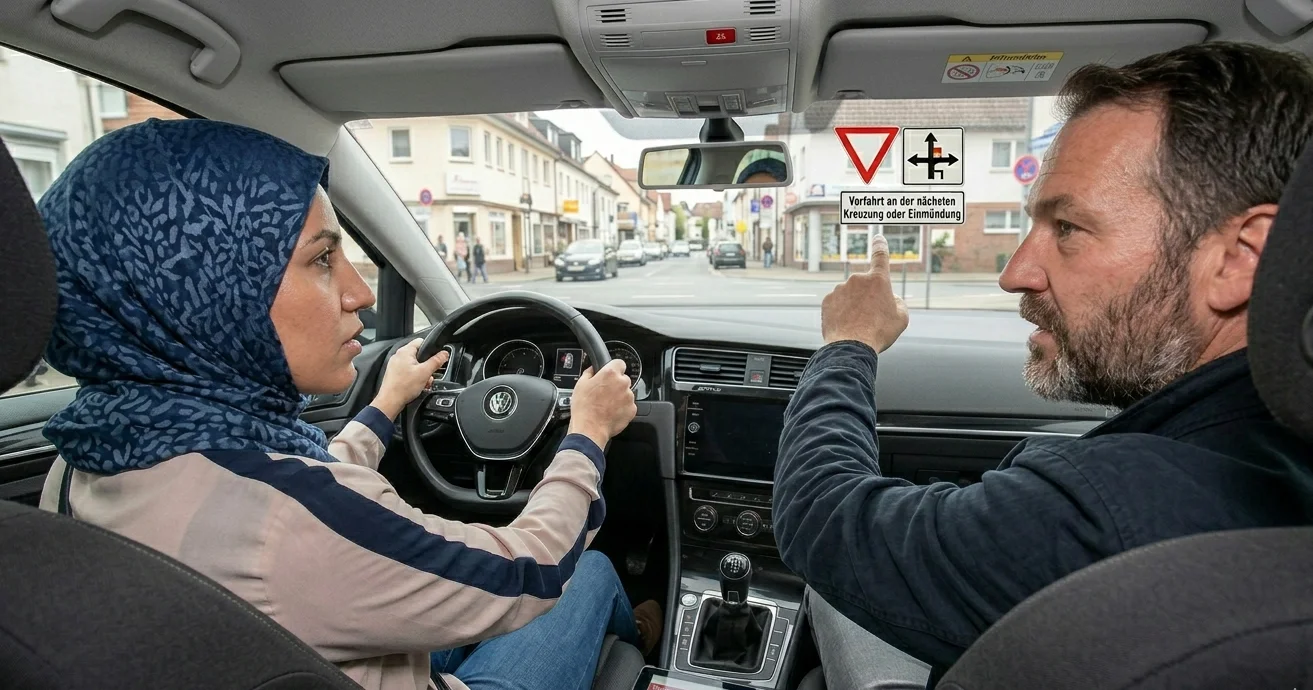
Getting a German driving licence is expensive, time-consuming, and conducted entirely in German — including the theory test, the lessons, the instructors' commands, and the examiner's instructions during the practical. Whether you are starting from scratch or converting a foreign licence, this guide gives you every phrase, every command, every road sign vocabulary word, and every piece of knowledge that stands between you and passing.
Germany takes its driving licences seriously. The Führerschein (driving licence) is not just a document that lets you drive — it is a legally significant credential that requires substantial investment of time and money to obtain. The average new driver in Germany spends €1,500–3,500 and invests six to twelve months in the process. That is a significant commitment, and doing it in a foreign language makes it considerably harder.
This guide covers the entire journey: enrolling in a Fahrschule, understanding what the different compulsory lessons mean, passing the Theorieprüfung, working with your driving instructor in German, and navigating the Praktische Prüfung — including what the examiner says and exactly how to respond.
The German driving licence process is longer and more structured than in most countries. There is no shortcut — each step must be completed in order. Understanding the whole sequence prevents surprises.
Register with an accredited driving school. Bring ID, your Anmeldung, a biometric passport photo, and your Sehtest (eye test certificate). Some schools require a Erste-Hilfe-Kurs (first aid course) before starting.
Cost: registration fee €20–50 + first aid course €25–40A one-day course — approximately 9 hours. Legally required before sitting the theory exam. Covers basic life-saving measures, CPR, and accident procedure.
Cost: €25–40. Certificates are valid indefinitely.A simple visual acuity test — available at most opticians for €5–10. The certificate is submitted to the Fahrschule.
Cost: €5–10 at an optician (Optiker)Group classroom lessons at the Fahrschule covering road rules, signs, priority rules, and road safety. Minimum 12 hours of theory instruction required, including 4 hours of specialist topics. Most students attend 2–3 lessons per week.
Cost: included in the school's base package or per-lesson fee30 questions with weighted scoring at a TÜV or DEKRA centre. Maximum 10 penalty points allowed to pass. The test is available in multiple languages — ask your school.
Exam fee: €22.49 (standard). Repeat: same fee each time.No fixed minimum of practical hours — but the school must confirm you are ready. Typically 20–40 lessons for beginners. Must include the 3 Sonderfahrten (Überlandfahrt, Autobahnfahrt, Nachtfahrt).
Cost: €40–65 per lesson. This is where the main expense lies.Approximately 45 minutes of driving with a TÜV/DEKRA examiner. Your instructor accompanies in the back seat but may not intervene. One chance every 2 weeks if you fail.
Exam fee: €101.50 (standard). Each repeat: full fee again.The new EU-format card licence is issued by your Führerscheinstelle (licence office) — usually at the Bürgeramt or Straßenverkehrsamt. Processing takes 1–4 weeks. You can drive on a paper document in the meantime.
Licence fee: €40–50 at the FührerscheinstelleThe full German driving licence process — first aid course, eye test, theory lessons, theory exam, practical lessons, practical exam, licence fee — typically costs between €1,500 and €3,500 for a new driver. This is significantly higher than most other countries. Budget generously, especially for practical lessons. Every failed exam costs another €100+.
| Document | Details |
|---|---|
| Personalausweis / Reisepass | ID or passport — original required |
| Meldebescheinigung (Anmeldung) | Proof of German registered address |
| Biometrisches Lichtbild | Biometric passport photo — same format as for a passport |
| Erste-Hilfe-Kurs Bescheinigung | First aid course certificate — if already completed |
| Sehtestbescheinigung | Eye test certificate from an optician |
| Ausländischer Führerschein | Foreign licence — if converting or wishing to waive some lessons |
Before sitting the practical exam, you must complete three specific types of driving experience. These cannot be substituted by regular lessons — they must be formally logged as completed.
Country road / rural road driving. Minimum 1 lesson. Covers overtaking, two-lane roads, rural junctions, speed limit changes, and interacting with slow vehicles.
Motorway driving. Minimum 1 lesson. Covers merging, lane discipline, high-speed driving, overtaking on the motorway, and leaving at junctions.
Night driving. Minimum 1 lesson. Conducted after dark — covers headlight usage, reduced visibility, judging speed and distance at night.
Your driving training record. Each lesson and Sonderfahrt is logged here. The examiner checks this before the practical exam — make sure your instructor keeps it updated.
The Theorieprüfung consists of 30 questions with a weighted penalty point system. Some questions carry 2 penalty points, some carry 3 or 4. You fail if you accumulate more than 10 penalty points. This means you can get some questions wrong — but not the high-value ones.
The theory exam is available in multiple languages at TÜV and DEKRA centres, including Turkish, Arabic, Russian, Polish, and English. Ask your Fahrschule to register you for the exam in your preferred language. The questions are the same — only the language changes. This is completely legal and widely used.
| Topic area | German name |
|---|---|
| Road signs | Verkehrszeichen / Schilder |
| Right of way rules | Vorfahrtregeln |
| Speed limits | Geschwindigkeitsbegrenzungen / Tempolimits |
| Alcohol and drugs | Alkohol und Drogen im Straßenverkehr |
| Vehicle safety | Fahrzeugsicherheit und Technik |
| First aid / accident procedure | Verhalten bei Unfällen / Erste Hilfe |
| Environmental awareness | Umweltbewusstes Fahren |
| Hazard recognition | Gefahrenlehre |
The official app Fahrschule.de and iFahrschule both offer the complete TÜV/DEKRA question bank in multiple languages. Practise all 1,000+ questions — the real exam draws directly from this pool. Most people need 4–8 weeks of regular app practice to pass comfortably. Do not underestimate the complexity of some questions.
German road signs follow the standard European system. Here are the most important signs by category, with their German names — which you will encounter in the theory test.
| Road type | Default speed limit | German term |
|---|---|---|
| Built-up area / town | 50 km/h | Innerorts |
| Rural road / country road | 100 km/h | Außerorts (Landstraße) |
| Motorway (cars) | No general limit (Richtgeschwindigkeit 130) | Autobahn |
| Zone 30 | 30 km/h | Tempo-30-Zone |
| Pedestrian zone | Walking pace (~7 km/h) | Fußgängerzone |
| Shared zone | 7 km/h | Verkehrsberuhigter Bereich |
Germany is famous for having no general speed limit on sections of the Autobahn. The recommended speed (Richtgeschwindigkeit) is 130 km/h — but it is not legally binding. However, if you drive faster than 130 and have an accident, your liability increases. Many Autobahn stretches now have permanent or variable speed limits. During the practical exam, you will not be tested at unlimited speed — the examiner will specify what speed is appropriate.
During driving lessons, your instructor will give commands in German. Understanding them instantly — without needing to translate in your head — is essential for safety. Here are the commands you will hear most often, grouped by what they ask you to do.
| German command | What to do |
|---|---|
| Fahren Sie los. / Starten Sie. | Move off. / Start driving. |
| Anhalten bitte. / Halten Sie an. | Stop please. / Come to a stop. |
| Bremsen bitte. | Brake please. |
| Beschleunigen Sie. / Gas geben. | Accelerate. / Give it some throttle. |
| Schalten Sie hoch / runter. | Change up / change down a gear. |
| Kupplung kommen lassen. | Release the clutch smoothly. |
| Handgas geben. | Give a little throttle by hand. (Usually during hill starts) |
| German command | What to do |
|---|---|
| Biegen Sie rechts / links ab. | Turn right / left. |
| Geradeaus weiterfahren. | Continue straight ahead. |
| An der nächsten Kreuzung rechts. | At the next junction, turn right. |
| Bitte wenden. | Please turn around / make a U-turn. |
| Ordnen Sie sich rechts / links ein. | Move into the right / left lane. |
| Überholen Sie das Fahrzeug vor Ihnen. | Overtake the vehicle in front of you. |
| Fahren Sie auf die Autobahn auf. | Merge onto the motorway. |
| Verlassen Sie die Autobahn an der nächsten Ausfahrt. | Exit the motorway at the next junction. |
| German command | What to do |
|---|---|
| Parken Sie hier bitte ein. | Please park here. |
| Parallel einparken bitte. | Parallel park please. |
| Rückwärts einparken bitte. | Reverse into the space please. |
| Fahren Sie rückwärts. | Drive in reverse. |
| Halten Sie am rechten Fahrbahnrand an. | Stop at the right side of the road. |
| Motor abstellen bitte. | Switch off the engine please. |
| Handbremse anziehen. | Apply the handbrake. |
| German command | What to do |
|---|---|
| Blinker setzen / Blinker an. | Indicate / put the indicator on. |
| Schulterblick bitte. | Shoulder check please — look over your shoulder before changing lane or pulling out. |
| Spiegel kontrollieren. | Check your mirrors. |
| Vorfahrt beachten. | Observe the right of way / give way to traffic with priority. |
| Geschwindigkeit anpassen. | Adjust your speed. |
| Abstand halten. | Keep your distance / maintain safe following distance. |
| Sicherheitsabstand einhalten. | Maintain the safety distance. |
| Achtung — Fußgänger / Radfahrer. | Watch out — pedestrian / cyclist. |
The practical exam lasts approximately 45 minutes. A TÜV or DEKRA examiner sits in the front passenger seat. Your instructor sits silently in the back — they may not help you. The examiner gives directions and assesses your driving. You are allowed to ask for clarification if you don't understand an instruction.
| Question in German | What they're asking |
|---|---|
| Zeigen Sie mir den Ölmessstab. | Show me the oil dipstick. |
| Wo befindet sich der Kühlwasserbehälter? | Where is the coolant reservoir? |
| Wie prüfen Sie den Reifendruck? | How do you check tyre pressure? |
| Wo ist die Scheibenwaschanlage? | Where is the windscreen washer reservoir? |
| Wie prüfen Sie die Profiltiefe der Reifen? | How do you check tyre tread depth? |
| Zeigen Sie mir, wie Sie die Hauptlichtanlage prüfen. | Show me how you check the main lights. |
Failing the practical exam is genuinely common — approximately 30–35% of candidates fail on the first attempt in Germany. It is not a catastrophe. Here is what happens next and what to say.
| After failing | What you need to know |
|---|---|
| Wartezeit (waiting period) | You must wait at least 2 weeks before retaking. Use this time for targeted lessons on what failed. |
| Prüfungsgebühr (exam fee) | The full €101.50 fee is due again for every retake. There is no discount for repeat candidates. |
| Prüfungsprotokoll (exam report) | Ask the examiner or your Fahrschule for the written report. It lists every error and its severity. Study it carefully. |
| Gefährliche Fehler (dangerous errors) | Errors classified as "gefährlich" (dangerous) result in automatic failure regardless of other performance. |
| Fehlerprotokoll besprechen | Review the report with your instructor before booking more lessons. |
The examiner's written report after a failed exam is one of the most useful documents in the whole process. It lists each error precisely — what happened, when it happened, and how serious it was. Many people throw it away or don't request it. Always ask: "Kann ich bitte das Prüfungsprotokoll erhalten?" — it tells you exactly what to fix.
If you hold a valid driving licence from another country, you may be able to convert it to a German licence without taking the full test. The rules depend heavily on which country issued your licence.
| Country of origin | Conversion process |
|---|---|
| EU / EEA countries | Direct exchange — no theory or practical test required. Administrative conversion only. Bring your licence, ID, Anmeldung, photo, and fee to the Führerscheinstelle. |
| Countries with EU reciprocal agreements (e.g. South Korea, Japan, Switzerland) | Usually converted with minimal or no testing. Confirm exact requirements at your local Führerscheinstelle. |
| Turkey | Theory test not required, but practical exam IS required. Some theory lessons may also be required — check with your Fahrschule. |
| USA, Canada, Australia, New Zealand | Usually only practical exam required, not theory. Confirm at local Führerscheinstelle — rules vary by Bundesland. |
| Countries without reciprocal agreements | Full process required — theory and practical exam, compulsory lessons. The foreign licence may reduce the number of lessons needed. |
New German drivers are subject to a two-year probationary period (Probezeit). During this time, specific rules apply that do not apply to experienced drivers.
| Rule during Probezeit | What it means |
|---|---|
| Probezeit duration | 2 years from the date of passing the practical exam |
| Blood alcohol limit | 0.0% — zero tolerance. Not 0.5% like regular drivers. Even one small beer can lead to a fine and licence points. |
| A-Verstöße (serious violations) | Running a red light, serious speeding, causing an accident: Probezeit extended to 4 years + mandatory driver training seminar (ASF) |
| B-Verstöße (minor violations) | Speeding, mobile phone use: two B-violations = same consequence as one A-violation |
| Begleitetes Fahren (BF17) | If you did BF17 (supervised driving from age 17), this counts towards your Probezeit |
The blood alcohol limit for drivers during Probezeit and for drivers under 21 is strictly 0.0% — not 0.5% like regular drivers. A single glass of wine or beer can bring you above this threshold. Violation results in a €250 fine, 1 point in Flensburg, Probezeit extended to 4 years, and a mandatory resocialisation seminar. Take this limit absolutely seriously during your first two years.
A final thought: the German driving licence is genuinely difficult to obtain, intentionally so. The theory is complex, the practical standards are high, and the costs are significant. But on the other side of it is a credential that is recognised across the EU, valid for decades, and built on a foundation of real competence. Every hour of preparation — in the classroom, on the road, and with this guide — is an investment in driving safely in one of the world's most demanding road environments. Gute Fahrt.
Want to practise driving school and examiner conversations in German before your lessons begin? Deutsch-Assistent covers every command and question.
Practise Your Driving German →