← Home | Blog
Deutsch Assistent
Public Transport in Germany: Trains, U-Bahn, Bus and Tram — Tickets, Announcements and Everything In Between
Surviving Germany — #10 Transport & Getting Around

Public Transport in Germany: Trains, U-Bahn, Bus and Tram — Tickets, Announcements and Everything In Between

Reading time: ~17 minutes  ·  S-Bahn, U-Bahn, Bus, Tram, Zug — all covered  ·  All levels welcome

The German public transport network is one of the best in the world — and one of the most linguistically dense for newcomers. Station names, ticket machines, zone systems, delay announcements, inspectors, and connection etiquette all come with their own specific German. This guide makes all of it readable — so you travel confidently from day one.

Germany's public transport is a layered system of networks, operators, and tickets that makes perfect sense once you understand the logic — and produces complete bewilderment until you do. The same train station might have S-Bahn, U-Bahn, regional trains, and long-distance ICE services all on different platforms, run by different operators, requiring different or overlapping tickets.

And then the announcement comes over the speaker — fast, clipped, loaded with technical vocabulary — and even intermediate German speakers find themselves staring at the ceiling wondering if they just missed their train.

This guide decodes it all: every ticket type, every announcement phrase, every machine screen, and every conversation you might need to have — from buying a ticket to explaining yourself to a Kontrolleur.

What's in this guide
  • 01 Essential vocabulary
  • 02 Types of transport
  • 03 Ticket types explained
  • 04 At the ticket machine
  • 05 Zone systems
  • 06 Validating your ticket
  • 07 Reading the departure board
  • 08 Announcements — decoded
  • 09 Asking for help
  • 10 On the train / U-Bahn
  • 11 Ticket inspectors
  • 12 Long-distance trains (DB)
  • 13 Delays and disruptions
  • 14 Bikes, prams and luggage
  • 15 Full survival card

01

Essential vocabulary — the language of German transport

der Bahnhof / der Hauptbahnhof (Hbf)
station / main station
"Am Hauptbahnhof umsteigen." — Change at the main station.
die Haltestelle
stop (for bus, tram, U-Bahn)
"Die nächste Haltestelle ist Marienplatz."
der Fahrschein / das Ticket
ticket
Both terms used — Fahrschein is more formal.
der Fahrkartenautomat
ticket machine
Found at every station and most tram stops.
das Fahrtziel
destination
"Bitte Fahrtziel eingeben." — Please enter your destination.
der Abfahrtsbahnsteig / das Gleis
departure platform / track
"Der Zug fährt auf Gleis 7 ab." — The train departs from platform 7.
umsteigen
to change (trains / lines)
"Bitte in Richtung Stadtmitte umsteigen."
einsteigen / aussteigen
to board / to get off
"Bitte einsteigen und Türen schließen."
die Abfahrt / die Ankunft
departure / arrival
On departure boards: Abfahrt = times of departure.
der Anschluss
connection (transport link)
"Sie haben Anschluss an die S3." — You have a connection to the S3.
die Verspätung
delay
"Der Zug hat 12 Minuten Verspätung." — The train is 12 minutes late.
die Störung / die Betriebsstörung
disruption / service disruption
The word that triggers mild panic on any platform.
der Schienenersatzverkehr (SEV)
rail replacement service (bus)
When trains can't run — replacement buses operate instead.
die Tarifzone / der Geltungsbereich
fare zone / area of validity
Your ticket is valid within specific zones.
entwerten
to validate / stamp a ticket
Required for some paper tickets — using the orange machine on the platform.
der Kontrolleur / die Kontrolleurin
ticket inspector
"Fahrkarten bitte!" — Tickets please!
Schwarzfahren
travelling without a valid ticket
Results in an "erhöhtes Beförderungsentgelt" (EBE) — a fine of €60 in most cities.
das erhöhte Beförderungsentgelt (EBE)
penalty fare / fine
€60 in most German cities. Cannot be waived.
der Verkehrsverbund
transport association / network
The body that coordinates all local transport. MVV (Munich), VBB (Berlin), HVV (Hamburg), VRS (Cologne), RMV (Frankfurt).
das Deutschlandticket
Germany-wide monthly ticket
€49/month for unlimited travel on all local and regional public transport across Germany. Valid on all S-Bahn, U-Bahn, bus and tram — not on ICE, IC or long-distance trains.

02

Types of transport — what's what

ICE
InterCityExpress

Germany's fastest trains. Up to 300 km/h. Inter-city and international routes. Requires separate ticket — not covered by Deutschlandticket.

IC / EC
InterCity / EuroCity

Long-distance express trains. Slower than ICE. Also requires a full DB ticket — not covered by Deutschlandticket.

RE / RB
Regional trains

RegionalExpress / RegionalBahn. Connect cities and towns. Covered by Deutschlandticket. Often chaotic during peak hours.

S-Bahn
City rail / suburban rail

Fast urban rail network. Runs above and below ground. Covered by local network tickets and Deutschlandticket. Key for connecting suburbs to city centres.

U-Bahn
Underground / metro

Entirely underground rapid transit. Only in larger cities (Berlin, Munich, Hamburg, Frankfurt, etc.). Covered by local network tickets.

Straßenbahn
Tram / streetcar

Surface-level rail running on city streets. Very common — some cities (Freiburg, Erfurt) rely heavily on trams. Covered by local network tickets.

Bus
City bus / regional bus

Fills gaps between rail lines. City buses are covered by local tickets. Regional buses may need separate tickets in some areas.

Fähre
Ferry

In cities with rivers or lakes (Hamburg, Berlin). Often covered by local network tickets. Check specific routes.

Nachtbus
Night bus

Runs when U-Bahn/S-Bahn stops (typically 1–4am). Designated routes cover key corridors. Check local Nachtliniennetz.

The Deutschlandticket — a revolution in German transport

Since May 2023, the Deutschlandticket (€49/month, sometimes called the "49-Euro-Ticket") allows unlimited travel on all local and regional public transport across Germany — S-Bahn, U-Bahn, bus, tram, and regional trains (RE/RB). It does not cover ICE, IC, or EC trains. Purchased as a subscription via apps, your local transport authority's website, or at certain counters. For anyone living and commuting in a German city, this is almost always the most cost-effective option.


03

Ticket types — what to buy and when

For one journey
Einzelfahrschein

Single ticket valid for one journey including changes within the zone. Time-limited (usually 1–2 hours). Most expensive per journey.

For a full day
Tageskarte / Tageskarte Solo

Day ticket valid from validation until end of service that day. Worth it after 3+ journeys. Valid for one person on all local transport in the zone.

For a group
Tageskarte Gruppe / Partner

Group day ticket — covers up to 5 people for the full day. Extremely cost-effective for families or groups of 3+.

For a week
Wochenkarte

7-day ticket. Available at most transport authority offices or apps. Economical for short-term stays.

For a month
Monatskarte

Monthly pass for unlimited travel in your zone. Available at ticket offices and via apps. For most regular commuters, the Deutschlandticket has replaced this.

Germany-wide
Deutschlandticket

€49/month subscription for unlimited local and regional transport nationwide. S-Bahn, U-Bahn, bus, tram, RE, RB — everywhere in Germany. Does NOT cover ICE/IC.

The single most important ticket decision for newcomers: if you use public transport more than twice a day, the Deutschlandticket at €49/month is almost certainly cheaper than buying individual tickets. Even a daily Einzelfahrschein for two zones in Munich costs around €3.90 — that's €7.80/day, over €160/month. The Deutschlandticket pays for itself in about a week of regular use.


04

At the ticket machine — Fahrkartenautomat

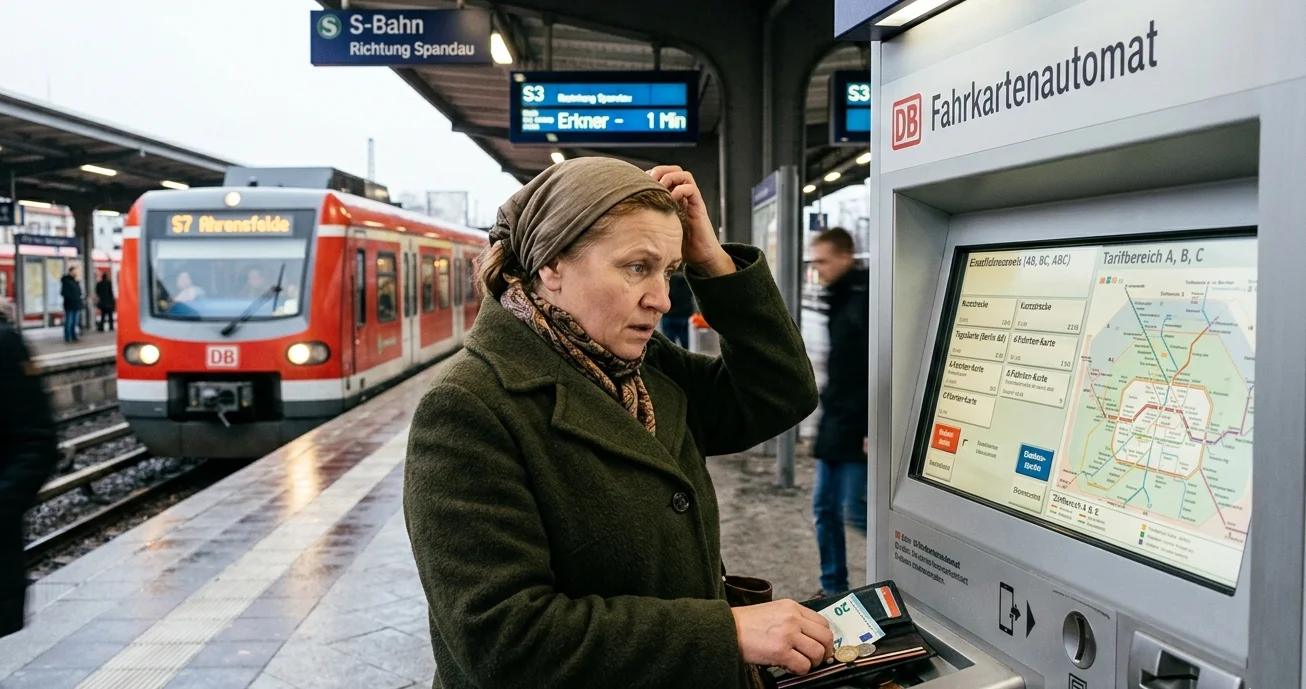
The German Fahrkartenautomat (ticket machine) is a well-designed but initially intimidating piece of engineering. Most modern machines have a language option button — look for a British flag or "English" at the start screen. But knowing the German is useful when the English option doesn't appear or when someone is helping you.

Ticket machine — common screen options
Fahrtziel eingebenEnter destination
KurzstreckeShort hop / short trip (reduced fare for 1–4 stops)
EinzelfahrtSingle journey
TageskarteDay ticket
Gruppenkarte / PartnerkarteGroup ticket
ErwachsenerAdult
Kind (6–14 Jahre)Child (6–14 years)
Streifen / MehrfahrtenkarteStrip ticket / multi-journey card
Zone A / Zone AB / GesamtnetzZone A / Zones A+B / Entire network
Geldscheine werden nicht angenommenBanknotes not accepted
Bitte zahlen Sie mit Münzen oder KartePlease pay with coins or card
Ticket entnehmenTake your ticket
Wechselgeld entnehmenTake your change
Quittung drucken?Print receipt?
Asking for help at the machine — Hilfe am Automaten
You
Entschuldigung, können Sie mir kurz helfen? Ich finde nicht das richtige Ticket. Excuse me, can you help me for a moment? I can't find the right ticket.
You
Ich möchte zum Hauptbahnhof fahren — welches Ticket brauche ich? I want to go to the main station — which ticket do I need?
You
Der Automat nimmt meine Karte nicht an — was soll ich tun? The machine isn't accepting my card — what should I do?
You
Gibt es hier eine Servicestelle, wo ich ein Ticket kaufen kann? Is there a service desk here where I can buy a ticket?
App alternative

All major German transport networks have official apps where you can buy and display tickets on your phone. DB Navigator (Deutsche Bahn), MVV Fahrinfo (Munich), VBB (Berlin), HVV (Hamburg), and the Deutschlandticket apps all work seamlessly. App tickets are typically displayed as a barcode or animated screen — no printing required. You validate by showing the screen to an inspector if asked.


05

Zone systems — understanding Tarifzonen

Most German city transport networks use a zone-based pricing system. Your ticket must cover all zones you travel through — not just your start and end zones. Understanding zones prevents accidentally buying the wrong ticket and getting fined.

Zone A

City centre and inner ring. Most urban journeys are Zone A only. Cheapest ticket.

Zone B

Outer city and near suburbs. An AB ticket covers Zones A and B — needed for many S-Bahn journeys.

Zone C

Outer suburbs and surrounding region. An ABC ticket covers the whole network. Needed for airport connections in some cities.

Zone naming varies by city. Berlin uses ABC zones. Munich uses ring zones (Innenraum, Gesamtnetz). Hamburg uses zones with ring letters. Always check which zone system your city uses — and which zones your specific journey covers — before buying a ticket. When in doubt, buy the zone that covers more rather than less. Upgrading at an inspector's request is not possible.

At the machine / asking about zonesEnglish
In welcher Zone liegt [Bahnhof]?Which zone is [station] in?
Reicht ein AB-Ticket für diese Fahrt?Is an AB ticket sufficient for this journey?
Ich brauche ein Ticket für alle Zonen.I need a ticket for all zones.
Gilt das Deutschlandticket für diese Strecke?Is the Deutschlandticket valid for this route?
Ist der Flughafen in Zone C?Is the airport in Zone C?

06

Validating your ticket — Entwerten

This is the step many newcomers miss — and it results in a fine even when they paid for a ticket. Some tickets must be validated (entwerted) in a stamping machine before you board. Others are pre-validated when purchased digitally or from certain machines.

Ticket typeDoes it need validation? Einzelfahrschein from a machineUsually pre-printed with time — check if it says "sofort gültig" (immediately valid). If not, validate in the orange Entwerter machine on the platform. App tickets (DB Navigator, MVV app)Activated in the app — no separate validation needed. Show your phone screen to the inspector. DeutschlandticketSubscription-based — simply show your app or card. No punching required. Paper day tickets / StreifenkarteMust be validated in the Entwerter machine. The orange machine stamps the time and date. Tickets bought at countersUsually pre-validated. Check the ticket — "bereits entwertet" or a printed timestamp means you're good to go.
Common mistake

Buying a paper strip ticket (Streifenkarte) or paper Einzelfahrschein and boarding without stamping it in the orange Entwerter machine. The ticket is technically not valid until stamped. Inspectors will fine you regardless of the fact you paid. Always stamp paper tickets before boarding — the machine is usually found at the top of U-Bahn stairs or on tram platforms.


07

Reading the departure board — Abfahrtstafel

German departure boards (digital or printed) follow a consistent format. Understanding each column takes less than five minutes — and saves enormous confusion.

Column / term on boardWhat it means
Abfahrt / ZeitDeparture time — the scheduled time
Zug / LinieTrain / line number — e.g. ICE 517, S3, U6, Bus 68
Richtung / ZielDirection / destination — where the service is going
Gleis / BahnsteigPlatform / track number — where to go
ca. +12 / +8 MinCurrent delay in minutes — "ca." means approximately
pünktlichOn time — the happiest word on any departure board
AusfallCancelled — the worst word on any departure board
fällt aus / entfälltIs cancelled / does not run today
Halt entfälltThis stop is skipped — the train does not stop here today
Gleis geändertPlatform changed — check the updated platform
über [Ort]Via [place] — the train stops there en route
werktags / täglich / nur Sa+SoOn working days / daily / Saturdays and Sundays only

08

Announcements — fully decoded

This is the section no other guide covers adequately. German transport announcements are fast, use highly specific vocabulary, and often contain critical information about delays, platform changes, or cancellations. Here is every important announcement type, written out and explained.

Standard boarding and arrival announcements

U-Bahn / Tram — standard
Nächste Haltestelle: Marienplatz. Ausstieg links.
Next stop: Marienplatz. Exit on the left.
U-Bahn / S-Bahn — doors
Bitte einsteigen und Türen schließen. Zurückbleiben bitte!
Please board and close the doors. Please stand back!
Heard just before doors close. "Zurückbleiben" = stay back / don't board.
S-Bahn — terminus
Endstation. Bitte alle aussteigen. Dieser Zug fährt nicht weiter.
End of the line. Please all alight. This train does not continue further.
S-Bahn / regional — connection
Sie haben Anschluss an die S3 Richtung Flughafen auf Gleis 5.
You have a connection to the S3 towards the airport on platform 5.
Long-distance — arrival
Sehr geehrte Damen und Herren, willkommen in München Hauptbahnhof. Wir haben planmäßig Ankunft um 14:32 Uhr. Achten Sie bitte auf Ihr Gepäck.
Ladies and gentlemen, welcome to Munich Main Station. We have arrived on schedule at 14:32. Please take care of your luggage.

Delay announcements

Delay announcement
Achtung auf Gleis 3. Der ICE 517 nach Berlin Hauptbahnhof hat heute circa 25 Minuten Verspätung. Wir bitten um Entschuldigung für die Unannehmlichkeiten.
Attention on platform 3. ICE 517 to Berlin Main Station is today approximately 25 minutes delayed. We apologise for the inconvenience.
"circa" / "ca." = approximately. "Unannehmlichkeiten" = inconveniences — a word you will hear very often.
Reason for delay
Dies ist auf eine Betriebsstörung im Bereich Hannover zurückzuführen.
This is due to a service disruption in the Hannover area.
Delay — no further information
Aufgrund einer technischen Störung ist die Einfahrt des Zuges noch nicht absehbar. Wir bitten um Ihre Geduld.
Due to a technical fault, the arrival of the train cannot yet be foreseen. We ask for your patience.
"nicht absehbar" = cannot be foreseen. This means: we don't know when it's coming. Plan accordingly.

Cancellation and platform change announcements

Cancellation
Achtung, Achtung. Der Regionalexpress 4251 nach Augsburg fällt heute leider aus. Der nächste Zug fährt um 14:52 Uhr auf Gleis 7.
Attention, attention. Regional Express 4251 to Augsburg is unfortunately cancelled today. The next train departs at 14:52 from platform 7.
Platform change
Achtung, Gleisänderung. Der ICE 509 nach Hamburg fährt heute abweichend von Gleis 12 ab, nicht von Gleis 8.
Attention, platform change. ICE 509 to Hamburg departs today from platform 12, not platform 8.
"abweichend von" = departing from (instead of the scheduled platform). "abweichend" is a key word in delay announcements.
Disruption — U-Bahn
Auf der U6 kommt es aufgrund einer Betriebsstörung zu Einschränkungen zwischen Garching und Marienplatz. Bitte nutzen Sie als Ersatz die S-Bahn-Linien S1 und S8.
On the U6, there are restrictions between Garching and Marienplatz due to a service disruption. Please use S-Bahn lines S1 and S8 as an alternative.
Rail replacement service
Zwischen Ostbahnhof und Pasing wird ein Schienenersatzverkehr mit Bussen eingesetzt. Die Busse halten direkt vor dem Haupteingang des jeweiligen Bahnhofs.
Between Ostbahnhof and Pasing, a rail replacement service with buses is in operation. The buses stop directly in front of the main entrance of each station.
"Schienenersatzverkehr" (SEV) = rail replacement bus. This is the announcement that makes commuters sigh collectively.

Safety and information announcements

Safety announcement
Bitte achten Sie auf Ihre persönlichen Gegenstände und verdächtige Gepäckstücke. Bitte sprechen Sie das Zugpersonal oder die Bundespolizei an.
Please take care of your personal belongings and any suspicious luggage. Please approach the train staff or the Federal Police.
Strike announcement
Aufgrund des aktuellen GDL-Streiks kommt es im gesamten Streckennetz zu erheblichen Beeinträchtigungen. Wir empfehlen, Ihre Reise wenn möglich zu verschieben.
Due to the current GDL strike, there are significant disruptions across the entire network. We recommend postponing your journey if possible.
GDL = Gewerkschaft Deutscher Lokomotivführer (train drivers' union). German rail strikes are announced in advance.

09

Asking for help — on the platform and on board

Asking which platform / which train — Welches Gleis?
You
Entschuldigung, von welchem Gleis fährt der Zug nach Nürnberg ab? Excuse me, from which platform does the train to Nuremberg depart?
You
Entschuldigung, ist das der Zug nach Frankfurt? Excuse me, is this the train to Frankfurt?
You
Hält dieser Zug auch in Mannheim? Does this train also stop in Mannheim?
You
Fährt die U3 in Richtung Innenstadt oder Richtung Norden? Is the U3 going towards the city centre or towards the north?
You
Wo muss ich umsteigen, um zum Flughafen zu kommen? Where do I need to change to get to the airport?
Asking on the train / bus — Im Fahrzeug
You
Entschuldigung, ist dieser Platz noch frei? Excuse me, is this seat still free?
You
Könnten Sie mir sagen, wann wir in Köln Hauptbahnhof ankommen? Could you tell me when we arrive at Cologne Main Station?
You
Ich glaube, ich bin falsch gefahren — wie komme ich zurück zur Hauptstraße? I think I've gone the wrong way — how do I get back to Hauptstraße?
You
Wo muss ich aussteigen für das Olympiastadion? Where do I need to get off for the Olympic Stadium?

10

On the train and U-Bahn — etiquette and practicalities

Seat reservations on long-distance trains

On ICE and IC trains, seats can be reserved for an additional fee (usually €4–6). Reservations are not mandatory — but unreserved seats are first-come, first-served. A reserved seat shows a digital display at the headrest showing the booked route. Sitting in a reserved seat and being asked to move is common and completely normal — just move politely.

Seat reservation situations — Sitzplatzreservierung
You
Entschuldigung, ich glaube, das ist mein reservierter Platz — Sitzplatz 42, Wagen 5. Excuse me, I think that is my reserved seat — seat 42, carriage 5.
You
Oh, tut mir leid — ich habe nicht gesehen, dass der Platz reserviert ist. Ich setze mich woanders hin. Oh, I'm sorry — I didn't see that the seat is reserved. I'll sit somewhere else.

Etiquette — the unwritten rules

SituationThe German norm
Phone calls on trainsKeep calls brief and speak quietly. Silent zones ("Ruhebereich") exist on some ICE carriages — no calls at all.
Music / headphonesHeadphones expected. No music through speakers in any vehicle.
Eating on long-distance trainsPerfectly acceptable on ICE/IC. On U-Bahn and S-Bahn in cities — technically allowed but often frowned upon for strong-smelling food.
Giving up your seatFor elderly, pregnant, or disabled passengers — offer your seat. Germans do this routinely.
Blocking doorsStanding in the doorway area is common on short urban journeys. Step off the vehicle to let others exit, then re-board.
Priority seating (Vorrangplätze)Marked with symbols — keep these free for those who need them. Germans take this seriously.
Cultural note — the Ruhebereich

Many ICE trains have a designated Ruhebereich (quiet zone) — usually in carriage 27 or 28 of a standard ICE composition. In the Ruhebereich, phone calls are not permitted, and talking should be minimal. Eating, reading, and sleeping are fine. The quiet zone is indicated by a symbol on the seat and at the carriage entrance. Respecting it is taken seriously by German rail travellers — ignoring it will earn you pointed looks and, occasionally, direct requests to move.


11

Ticket inspectors — Kontrolleure

Ticket inspectors (Kontrolleure, also called Fahrgastprüfer or simply "Kontrolleure") operate on all forms of German public transport. On U-Bahn and S-Bahn they are undercover until they produce their badge. On buses, the driver may check tickets. On long-distance trains, uniformed conductors (Zugbegleiter) walk through the carriages.

Ticket check — Fahrscheinkontrolle
Inspector
Fahrkarten bitte. / Tickets bitte. Tickets please.
You
Hier bitte — ich habe das Deutschlandticket auf meinem Handy. Here please — I have the Deutschlandticket on my phone.
You
Ich habe einen Einzelfahrschein — hier ist er. I have a single ticket — here it is.
Inspector
Dieser Fahrschein gilt nicht für diese Zone. Sie benötigen ein AB-Ticket. This ticket is not valid for this zone. You need an AB ticket.
You
Das wusste ich nicht — ich bin neu hier. Kann ich jetzt ein Upgrade kaufen? I didn't know that — I'm new here. Can I buy an upgrade now? In most cases: no. You pay the fine (EBE). Ignorance of the zone system is not a legal defence. Be polite — hostility makes it worse.
Inspector
Ich muss leider ein erhöhtes Beförderungsentgelt erheben. Das sind 60 Euro. Kann ich Ihren Personalausweis sehen? I unfortunately have to charge an increased fare. That is €60. May I see your ID?
You
Kann ich per Karte zahlen oder muss ich bar zahlen? Can I pay by card or do I need to pay cash?
If you don't have a valid ticket

The fine is €60 in most German cities (higher on DB trains). You cannot talk your way out of it. You cannot pay on the spot with a "deal." You provide your ID, receive a payment notice by post, and pay within the deadline. Being cooperative and polite reduces the chance of additional complications. Being aggressive or refusing to give your name can result in the police being called.


12

Long-distance trains — Deutsche Bahn specifics

Buying a DB ticket — DB Ticket kaufen
You
Ich möchte eine Fahrkarte von München nach Berlin, morgen, Abfahrt gegen 10 Uhr. I'd like a ticket from Munich to Berlin, tomorrow, departure around 10am.
Staff
Einfach oder hin und zurück? Single or return?
You
Einfach bitte. Erste Klasse oder Zweite Klasse — was ist günstiger? Single please. First class or second class — which is cheaper?
You
Ich möchte auch eine Sitzplatzreservierung — Fensterplatz wenn möglich, Fahrtrichtung. I'd also like a seat reservation — window seat if possible, in the direction of travel.
You
Gibt es ein Sparpreis-Ticket für diese Verbindung? Is there a discounted Sparpreis ticket for this connection? Sparpreis tickets are DB's advance-purchase discounted fares — the earlier you book, the cheaper they are. Non-refundable and tied to a specific train.

DB ticket types and key terms

DB termWhat it means
SparpreisAdvance discounted ticket — tied to specific train, non-refundable
Sparpreis SuperDeepest discount — very restricted, book weeks ahead
FlexpreisFlexible ticket — valid on any train on that day/route, refundable
BahnCard 25 / 50 / 100Loyalty card — 25%, 50%, or 100% discount on all DB tickets. Annual subscription.
Einfache FahrtSingle journey
Hin und RückfahrtReturn journey
1. Klasse / 2. KlasseFirst class / second class
SitzplatzreservierungSeat reservation — additional fee, recommended on busy routes
Fahrtrichtung / RückwärtsForward-facing / backward-facing seat
Zugbindung aufgehobenTrain binding lifted — your ticket is now valid on any train (due to major delay)
DB delay rights — Fahrgastrechte

If your DB train is delayed by 60 minutes or more at your destination, you are entitled to a 25% refund of your ticket price. 120+ minutes delay = 50% refund. File a claim via the DB Fahrgastrechte form online or at any DB service point. Keep your ticket and any documentation. These rights apply across all EU rail travel.


13

Delays and disruptions — handling the unexpected

Dealing with a delayed connection — Verspäteter Anschluss
You
Mein Zug hat Verspätung — werde ich meinen Anschluss in Frankfurt noch erreichen? My train is delayed — will I still make my connection in Frankfurt?
Staff
Leider nein — der Anschluss wird nicht gewartet. Ich buche Sie auf den nächsten Zug um. Unfortunately no — the connection will not wait. I'll rebook you onto the next train.
You
Kann ich auf einen früheren oder späteren Zug umbuchen? Can I change to an earlier or later train?
You
Mein Zug ist ausgefallen — was sind meine Optionen? My train has been cancelled — what are my options?
You
Aufgrund der Verspätung habe ich meinen Anschluss verpasst — wer kommt für die Mehrkosten auf? Due to the delay I missed my connection — who covers the additional costs? With a Flexpreis ticket and a missed connection due to DB's fault, DB is responsible. Ask at the DB Servicecenter at the station.

14

Bikes, prams and luggage

SituationKey German phrases
Taking a bicycle on the trainGibt es ein Fahrradabteil? / Brauche ich eine Fahrradkarte? — Is there a bicycle compartment? / Do I need a bicycle ticket?
Prams and buggiesKinderwagen are usually free on all local transport. Look for the Mehrzweckabteil (multi-purpose area) or the wheelchair / pram symbol on the carriage.
Large luggage on S-Bahn / U-BahnGroßes Gepäck allowed — no extra charge. Be considerate of space during rush hour.
Lost propertyIch habe etwas im Zug vergessen. / Wo ist das Fundbüro? — I left something on the train. / Where is the lost property office?
Wheelchair / accessibilityGibt es eine Rampe für Rollstühle? / Ist dieser Zug barrierefrei? — Is there a ramp for wheelchairs? / Is this train step-free?

15

Your complete public transport survival card

Surviving Germany — Public Transport Phrase Card
Von welchem Gleis fährt der Zug nach [Ziel] ab?
From which platform does the train to [destination] depart?
Welches Ticket brauche ich für diese Fahrt?
Which ticket do I need for this journey?
Gilt das Deutschlandticket für diese Strecke?
Is the Deutschlandticket valid for this route?
Muss ich das Ticket entwerten?
Do I need to validate the ticket?
Ist das der Zug nach [Ziel]?
Is this the train to [destination]?
Hält dieser Zug in [Ort]?
Does this train stop in [place]?
Wo muss ich umsteigen?
Where do I need to change?
Wo muss ich aussteigen für [Ziel]?
Where do I need to get off for [destination]?
Wie viel Verspätung hat der Zug?
How much delay does the train have?
Ist dieser Platz noch frei?
Is this seat still free?
Ich habe meine Verbindung verpasst — was sind meine Optionen?
I missed my connection — what are my options?
Ich habe etwas im Zug vergessen — wo ist das Fundbüro?
I left something on the train — where is the lost property office?
Hier ist mein Ticket. / Ich habe das Ticket auf dem Handy.
Here is my ticket. / I have the ticket on my phone.
Gibt es ein Sparpreis-Ticket für diese Verbindung?
Is there a discounted Sparpreis ticket for this connection?

One final thought: once you understand the system — the zone logic, the ticket types, the announcement vocabulary — German public transport becomes one of the most reliable, comfortable, and cost-effective ways to travel in Europe. The Deutschlandticket in particular is a genuine gift: €49 a month to travel anywhere in the country on local and regional transport. Learn the language of the network, and the network works beautifully for you.


Want to practise public transport conversations in German — from buying a ticket to talking to an inspector? Deutsch-Assistent has you covered, stop by stop.

Practise Your Transport German →
People also search for
#how to use public transport in germany
#db navigator app guide
#german train announcements explained
#u-bahn and s-bahn difference
#buying a train ticket in germany
#schwarzfahren penalty germany
#german train station vocabulary
#public transport etiquette germany
#bahncard explained for expats