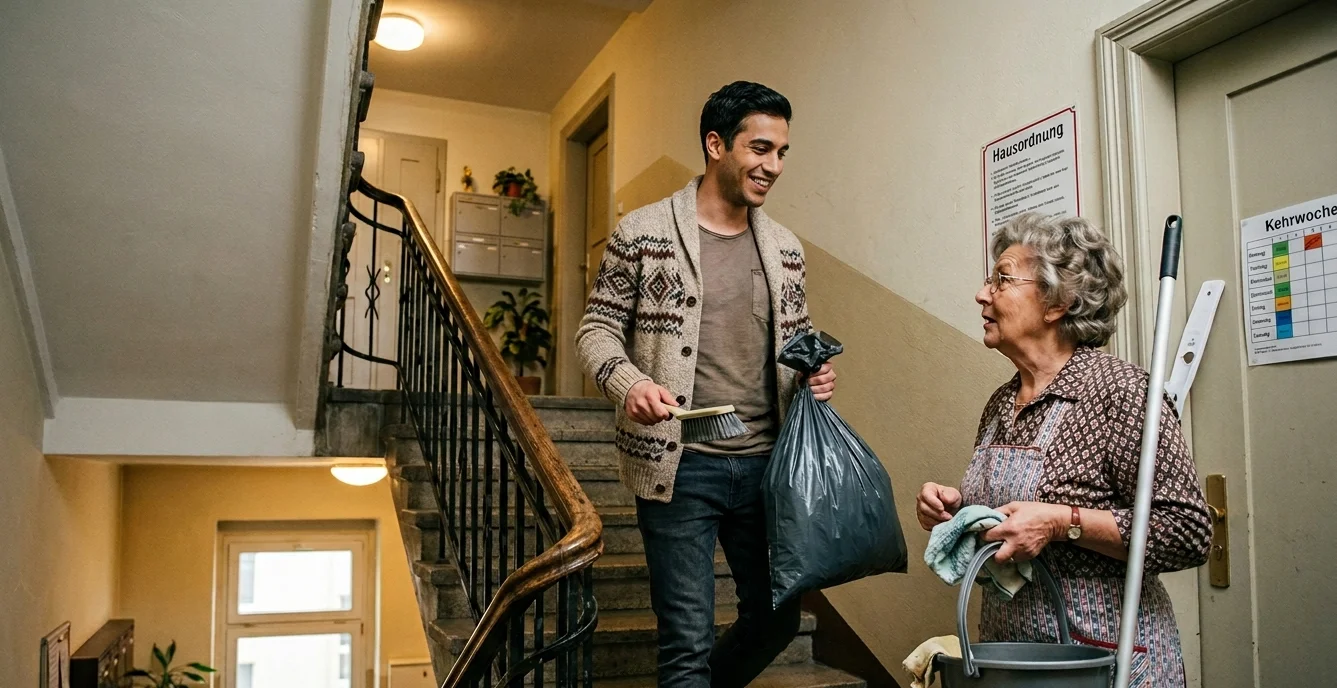
Surviving Germany — #12
Neighbourhood & Community
Neighbours and Building Life in Germany: Hausordnung, Noise, the Hausmeister and How to Live Well With Germans
Reading time: ~17 minutes · The most cultural guide in the series · All levels welcome
Of all the adjustments involved in moving to Germany, the ones that catch people most off guard are not bureaucratic — they are social. The rules of apartment building life in Germany are precise, passionately upheld, and almost entirely unwritten. This guide writes them down. All of them.
German apartment buildings operate according to a social contract that is, by international standards, unusually detailed. There are rules about noise — and specific hours during which different types of noise are forbidden. There are rules about cleaning the stairwell — and whose turn it is. There are rules about recycling — and which bag goes in which bin. There are rules about when you can hang laundry, when you can use the garden, and what time your washing machine may run.
These rules are not suggestions. They are the Hausordnung — and understanding them is the single most important thing you can do to build a peaceful relationship with the building you live in, and the people who live next to you.
This guide covers the Hausordnung in full, every type of interaction with neighbours, the Hausmeister (building caretaker), and the Hausverwaltung (property management). It includes the German to greet politely in the hallway, to raise a noise complaint without creating a feud, to write a formal letter of objection, and to receive one without panic.
What's in this guide
- 01 Essential vocabulary
- 02 The Hausordnung explained
- 03 Quiet hours — Ruhezeiten
- 04 Rubbish & recycling rules
- 05 Shared spaces
- 06 Hallway greetings
- 07 Raising a noise complaint
- 08 Receiving a complaint
- 09 The Hausmeister
- 10 The Hausverwaltung
- 11 Reporting defects
- 12 Letter templates
- 13 Disputes & escalation
- 14 Building community
- 15 Full survival card
01
Essential vocabulary — the language of building life
die Hausordnung
house rules / building regulations
The document governing all shared life in the building. Usually posted in the hallway and included with your rental contract.
die Ruhezeit
quiet hours
Legally protected periods during which noise must be kept to a minimum.
der Hausmeister / die Hausmeisterin
building caretaker / superintendent
Manages maintenance, cleaning, and minor repairs. Your first call for most building issues.
die Hausverwaltung
property management company
Manages the building on behalf of the owner. Handles contracts, major repairs, disputes.
der Nachbar / die Nachbarin
neighbour
"Mein Nachbar macht zu viel Lärm." — My neighbour makes too much noise.
der Lärm
noise / racket
The word at the centre of most building disputes. "Lärmbelästigung" = noise nuisance.
der Treppenflur / das Treppenhaus
stairwell / hallway
Shared space. Cleanliness is everyone's responsibility — often on a rota.
der Keller
basement / cellar
Each flat usually has a storage unit in the basement. Locked with your key.
der Innenhof / der Hof
inner courtyard / back yard
Shared outdoor space. Rules apply — noise, barbecuing, children's play.
der Müll / die Mülltrennung
rubbish / waste separation
Germany's bin system has separate containers for each waste type.
der Waschkeller / Waschraum
laundry room / utility room
Shared washing machines — often on a booking rota per flat.
der Putzdienst / Treppenhausreinigung
cleaning rota / stairwell cleaning
Each flat takes a turn cleaning the shared areas. Failing to do so is a serious breach of etiquette.
der Mangel / der Defekt
defect / fault in the flat or building
Must be reported promptly to the Hausverwaltung in writing.
die Beschwerde
complaint / formal objection
"Ich möchte eine Beschwerde einreichen." — I'd like to file a complaint.
die Abmahnung
formal warning letter
A serious document. Repeated Abmahnungen can lead to contract termination.
die Kündigung wegen Hausfriedensstörung
eviction for disturbing the peace
The ultimate consequence of persistent rule violations.
02
The Hausordnung — Germany's house rules document
The Hausordnung is a written document, usually displayed in the stairwell and/or attached to your rental contract, that governs life in the shared building. It has legal weight — violations can lead to formal warnings and, in serious cases, contract termination. Reading it carefully when you move in is not optional. It is essential.
Hausordnungen vary by building and landlord, but almost all cover the same core areas. Here is what a typical one looks like — with an English explanation of each rule.
✗
Ruhestörungen sind in der Nachtruhe (22:00–6:00 Uhr) und der Mittagsruhe (13:00–15:00 Uhr) verboten.
Noise disturbances are prohibited during night quiet hours (10pm–6am) and midday quiet hours (1pm–3pm).
✗
Das Musizieren und Betreiben von Musikgeräten ist nur werktags von 8:00–12:00 Uhr und 15:00–20:00 Uhr gestattet. Sonntags ist Musizieren ganztägig untersagt.
Playing musical instruments or audio equipment is permitted only on weekdays 8am–12pm and 3pm–8pm. Musical instruments are entirely prohibited on Sundays.
✗
Das Aufstellen von Fahrrädern, Kinderwagen oder sonstigen Gegenständen im Treppenhaus ist aus Sicherheitsgründen untersagt.
Storing bicycles, prams, or any other objects in the stairwell is prohibited for safety reasons.
✓
Die Treppenhausreinigung erfolgt nach dem aushängenden Putzplan. Jede Partei ist für die ordnungsgemäße Reinigung in ihrer Woche verantwortlich.
Stairwell cleaning follows the posted cleaning rota. Each household is responsible for proper cleaning during their assigned week.
✓
Müll ist ausschließlich in den dafür vorgesehenen Behältern zu entsorgen. Eine korrekte Mülltrennung ist einzuhalten.
Rubbish must only be disposed of in the designated containers. Correct waste separation is mandatory.
!
Der Waschkeller ist nach einem Belegungsplan zu nutzen. Wäsche ist nach dem Waschen umgehend zu entfernen.
The laundry room must be used according to the booking schedule. Washing must be removed promptly after completion.
✗
Das Grillen auf Balkonen und im Innenhof ist nur nach vorheriger Absprache mit allen Parteien gestattet.
Barbecuing on balconies or in the courtyard is only permitted after prior agreement with all residents.
✓
Haustiere sind grundsätzlich erlaubt, sofern von ihnen keine unzumutbare Belästigung ausgeht. Eine Anmeldung beim Vermieter ist erforderlich.
Pets are generally permitted, provided they cause no unreasonable disturbance. Registration with the landlord is required.
!
Die Haustür ist nach 22:00 Uhr stets abzuschließen. Das Zulassen fremder Personen ohne Wissen der übrigen Bewohner ist untersagt.
The main entrance door must always be locked after 10pm. Allowing unknown individuals entry without the knowledge of other residents is prohibited.
✓
Bei Beschwerden oder Anliegen wenden Sie sich zunächst direkt an den betroffenen Nachbarn, bevor Sie die Hausverwaltung einschalten.
For complaints or concerns, please first approach the neighbour directly before involving the property management.
Cultural note — the Hausordnung is taken seriously
In many countries, house rules are aspirational documents that people more or less ignore. In Germany, the Hausordnung is treated as a binding agreement. Neighbours genuinely keep track of violations. The Hausmeister will check that the cleaning rota is followed. A landlord who receives multiple complaints about a tenant can issue a formal Abmahnung — and three Abmahnungen can justify eviction. This is not an exaggeration. Understanding the rules and following them is not just politeness — it protects your tenancy.
03
Quiet hours — Ruhezeiten
Ruhezeiten are legally protected quiet periods during which neighbours have the right to undisturbed rest. German law does not prescribe exact hours uniformly — local regulations and individual Hausordnungen vary — but the following structure is near-universal across Germany.
Permitted noise
6:00–13:00
Morning hours. Normal domestic activity, music at reasonable volume, drilling and DIY permitted.
Mittagsruhe
13:00–15:00
Midday quiet period. Keep noise to a minimum. No drilling, no loud music, no power tools.
Permitted noise
15:00–22:00
Afternoon and evening. Normal activity. Music and conversation at moderate levels.
Nachtruhe
22:00–6:00
Night quiet period. Strict silence expected. No parties, no washing machines, no loud TV. Voices kept to a minimum.
Sonntagsruhe
Sundays all day
Sunday is treated as a rest day. No power tools, no drilling, no lawnmowers. Even louder music is generally frowned upon throughout Sunday.
DIY / Drilling
Mon–Sat only
Drilling and renovation work is permitted on weekdays and Saturdays only, during the permitted hours. Never on Sundays or public holidays.
One rule that surprises many newcomers: the washing machine. Running a washing machine during Nachtruhe (after 10pm) or during Mittagsruhe violates the Hausordnung in most buildings. Many buildings also have specific rules about when washing machines may run — check yours. The spin cycle of a washing machine is considered noise disturbance under German law.
04
Rubbish and recycling — Mülltrennung
Germany has one of the most thorough waste separation systems in the world. Getting this wrong is noticed — and neighbours will comment. The bins have specific colours and purposes that are consistent across Germany.
| Bin / Container | What goes in it |
|---|
| Gelbe Tonne / Gelber Sack (Yellow) | Packaging with the "Grüner Punkt" symbol — plastic, cans, composite packaging, foil, yoghurt pots, tin cans |
| Blaue Tonne (Blue) | Paper and cardboard — newspapers, cardboard boxes, magazines, office paper. Flatten cardboard first. |
| Braune Tonne / Biotonne (Brown) | Organic / food waste — vegetable peelings, fruit, coffee grounds, eggshells, small plant trimmings |
| Schwarze / Graue Tonne (Black / Grey) | Restmüll — everything that doesn't fit elsewhere: hygiene products, cat litter, broken ceramics, vacuum cleaner bags |
| Glascontainer (Glass banks) | Glass bottles and jars — separated by colour: Weißglas (clear), Braunglas (brown), Grünglas (green). Usually located near the building or at street corner points. |
| Wertstoffhof (Recycling centre) | Large items, electronics, furniture, paint, batteries, old appliances. Must be brought in person. Free for most items. |
| Sperrmüll (Bulky waste) | Large household items — collected on scheduled dates per district. Must be registered in advance. Cannot simply be left on the street. |
Common mistakes
Putting pizza boxes in the blue bin (they're contaminated with grease — goes in Restmüll). Putting glass in the yellow bin (always in the Glascontainer). Putting batteries in any bin (return to shops or the Wertstoffhof). These mistakes are noticed — by neighbours and by the bin collection company, which can refuse to empty a contaminated bin and leave a rejection notice.
Asking about rubbish — Fragen zur Mülltrennung
You
Entschuldigung, wo genau kommen die Glasflaschen hin?
Excuse me, where exactly do the glass bottles go?
Neighbour
Die Glascontainer stehen um die Ecke in der Bergstraße — getrennt nach Farben.
The glass banks are around the corner on Bergstraße — separated by colour.
You
Wann wird der Müll hier abgeholt?
When is the rubbish collected here?
You
Wohin mit dem alten Fernseher — gibt es einen Wertstoffhof in der Nähe?
Where does the old TV go — is there a recycling centre nearby?
05
Shared spaces — Gemeinschaftsbereiche
The stairwell cleaning rota — Putzplan
In most German apartment buildings, cleaning the shared stairwell is the responsibility of the residents — not a cleaning service. A Putzplan (cleaning rota) is posted in the stairwell, listing which flat is responsible for cleaning in which week. This means sweeping and mopping the stairs, cleaning the bannisters, and sometimes wiping down the letterboxes and windows.
Missing your turn is noticed. In small buildings especially, it creates genuine friction. If you cannot do your week, arrange a swap with another resident — and tell them in advance, not after.
Stairwell cleaning — Treppenhausreinigung
You
Entschuldigung, ich bin neu hier — können Sie mir erklären, wie der Putzplan funktioniert?
Excuse me, I'm new here — could you explain to me how the cleaning rota works?
Neighbour
Gerne. Jede Partei ist einmal im Monat dran — der Plan hängt unten neben dem Briefkasten.
Of course. Each household is responsible once a month — the schedule is posted downstairs next to the letterboxes.
You
Ich bin leider nächste Woche verreist — darf ich mit Ihnen tauschen?
I'm unfortunately away next week — may I swap with you?
The laundry room — Waschkeller
Using the shared laundry room
You
Wie funktioniert der Belegungsplan für den Waschkeller?
How does the booking system for the laundry room work?
You
Darf ich an diesem Tag / zu dieser Zeit die Waschmaschine benutzen?
May I use the washing machine on this day / at this time?
You
Jemand hat seine Wäsche seit zwei Tagen in der Maschine gelassen — was soll ich tun?
Someone has left their laundry in the machine for two days — what should I do?
Standard approach: wait one more day, then move it carefully to the basket nearby. Do not remove it immediately. And under no circumstances start your own wash on top of someone else's.
06
Hallway greetings — the daily ritual
The hallway greeting is one of the small but significant rituals of German building life. Germans do not go out of their way to socialise with neighbours — but they do greet them when encountered in shared spaces. The greeting is brief, warm enough, and non-committal. It maintains civility without requiring friendship. It is, in its way, a sophisticated social tool.
Hallway encounters — Im Treppenhaus
You
Guten Morgen! / Guten Tag! / Guten Abend!
Good morning! / Good day! / Good evening!
The correct greeting depends on time of day. "Guten Morgen" until about 11am, "Guten Tag" until early evening, "Guten Abend" after about 6pm.
Neighbour
Morgen! / Tag! / Abend!
The shortened casual response — very common. Equally warm, less formal.
You
Schönes Wochenende!
Have a nice weekend! — A universally safe parting phrase on Fridays.
You
Schönen Feierabend!
Enjoy your evening off! — Said when someone is clearly coming home from work.
You
Entschuldigung — ich bin neu hier. Ich bin [Name], aus Wohnung [Nummer].
Excuse me — I'm new here. I'm [Name], from flat [number].
Introducing yourself when you first move in is considered good form. A short, friendly self-introduction in the first week goes a long way.
You
Ich wollte mich kurz vorstellen — ich bin gerade neu eingezogen, in die Wohnung im dritten Stock.
I just wanted to briefly introduce myself — I've just moved in, to the flat on the third floor.
The introduction gift
In some parts of Germany, it is traditional to bring a small gift — a bottle of wine, chocolates, or flowers — when introducing yourself to close neighbours after moving in. This is entirely optional and more common in smaller buildings or traditional communities, but it creates an exceptionally warm first impression and is remembered positively for years. A modest, universally appealing gesture costs very little and pays dividends in goodwill.
07
Raising a noise complaint — the right way
The Hausordnung is clear: the first step is always to speak to the neighbour directly. Only if that fails should you involve the Hausmeister or Hausverwaltung. Going straight to management without speaking to your neighbour first is considered socially aggressive — even if you are entirely in the right.
Step 1 — The direct conversation
Knocking on the neighbour's door — Direktes Ansprechen
You
Guten Abend. Entschuldigen Sie bitte die Störung — ich wohne eine Etage tiefer. Ich wollte Sie höflich darauf ansprechen, dass die Musik bei mir unten sehr laut ankommt.
Good evening. I'm sorry to disturb you — I live one floor below. I wanted to politely raise with you that the music is coming through very loudly downstairs.
Neighbour
Oh, das wusste ich nicht — es tut mir leid. Ich stelle es sofort leiser.
Oh, I didn't know that — I'm sorry. I'll turn it down right away.
You
Vielen Dank, das ist sehr freundlich. Ich wollte nur kurz Bescheid geben.
Thank you very much, that's very kind. I just wanted to let you know briefly.
If the problem continues or they are not cooperative
You
Guten Abend. Wir haben das Thema letzte Woche schon kurz besprochen — leider ist die Lärmsituation weiterhin problematisch für mich. Ich bitte Sie nochmals, nach 22 Uhr auf die Lautstärke zu achten.
Good evening. We briefly discussed this topic last week — unfortunately the noise situation is still problematic for me. I ask you again to be mindful of the volume after 10pm.
You
Wenn sich das nicht ändert, werde ich mich leider an die Hausverwaltung wenden müssen.
If this doesn't change, I will unfortunately have to contact the property management.
Say this calmly and without aggression. It signals seriousness without escalating into a confrontation.
Step 2 — Contacting the Hausmeister or Hausverwaltung
Reporting repeated noise — Wiederholte Lärmbelästigung melden
You
Ich möchte eine Lärmbelästigung melden. Mein Nachbar aus Wohnung [Nummer] macht regelmäßig nach 22 Uhr sehr laute Musik.
I'd like to report a noise nuisance. My neighbour from flat [number] regularly plays very loud music after 10pm.
You
Ich habe ihn bereits zweimal persönlich angesprochen — leider ohne Wirkung.
I have already spoken to him directly twice — unfortunately without effect.
You
Ich habe die Vorfälle mit Datum und Uhrzeit dokumentiert — hier sind die Aufzeichnungen.
I have documented the incidents with date and time — here are the records.
Always keep a written log of noise incidents: date, time, duration, and nature of the noise. This documentation is essential if the matter escalates.
You
Ich bitte Sie, diesem Nachbarn eine formelle Abmahnung zu schicken.
I ask you to send this neighbour a formal warning letter.
08
Receiving a noise complaint — what to do
You might be on the receiving end. A neighbour knocks, a letter arrives from the Hausverwaltung, or a note appears in your letterbox. Here is how to respond — in German and in attitude.
Receiving a complaint at the door — Beschwerde entgegennehmen
Neighbour
Guten Abend. Die Musik bei Ihnen ist leider sehr laut bei uns zu hören.
Good evening. Your music is unfortunately very audible at our place.
You
Oh, das tut mir wirklich leid — das wusste ich nicht. Ich stelle es sofort leiser.
Oh, I'm truly sorry — I didn't know that. I'll turn it down right away.
You
Vielen Dank, dass Sie direkt bei mir geklingelt haben — das schätze ich sehr.
Thank you very much for coming directly to me — I really appreciate that.
You
Wir haben morgen eine kleine Feier — ich wollte Sie eigentlich noch warnen und fragen, ob das in Ordnung ist.
We're having a small gathering tomorrow — I actually wanted to warn you and ask whether that's alright.
Proactively informing neighbours before a party or louder event is considered very considerate — and dramatically reduces the chance of a complaint.
Cultural note — the advance warning
One of the most effective goodwill gestures in German building life is advance warning before a gathering. A note in the letterboxes of immediate neighbours — "Dear neighbours, I am having a small gathering on Saturday evening. I will do my best to keep it quiet, but please ring my bell if it becomes too much" — completely changes the dynamic. Neighbours who were warned are dramatically less likely to complain. It signals respect, and in Germany, respect is the currency of peaceful coexistence.
09
The Hausmeister — your first point of contact
The Hausmeister (building caretaker) is the person who keeps the building running. They handle minor repairs, maintain shared areas, manage the cleaning rota, accept deliveries, and act as the first point of contact for most building issues. They are not the landlord — but they often have direct contact with the Hausverwaltung and can escalate issues quickly.
Talking to the Hausmeister — Gespräch mit dem Hausmeister
You
Guten Tag. Ich bin neu eingezogen — in Wohnung [Nummer]. Ich wollte mich kurz vorstellen.
Good day. I've just moved in — flat [number]. I just wanted to briefly introduce myself.
You
Es gibt einen kleinen Wasserschaden im Bad — die Decke ist feucht. Können Sie sich das ansehen?
There's a small water leak in the bathroom — the ceiling is damp. Could you take a look?
You
Die Heizung in meiner Wohnung funktioniert nicht richtig. Wer ist dafür zuständig?
The heating in my flat isn't working properly. Who is responsible for this?
You
Das Licht im Keller ist ausgefallen — wissen Sie, wer sich darum kümmert?
The light in the cellar has gone out — do you know who deals with that?
You
Wo befindet sich der Abstellraum für die Partei aus Wohnung [Nummer]?
Where is the storage room for flat [number]?
You
Ich habe ein Paket für Sie angenommen — es liegt bei mir, wenn Sie es abholen möchten.
I accepted a parcel for you — it's with me if you'd like to collect it.
Accepting deliveries for neighbours is common courtesy in German buildings. Leave a note in their letterbox: "Ihr Paket liegt bei mir — Wohnung [Nummer]." (Your parcel is with me — flat [number].)
10
The Hausverwaltung — property management
The Hausverwaltung manages the building on behalf of the owner. They handle contracts, major repairs, neighbour disputes that couldn't be resolved directly, and formal complaints. Contact should usually be in writing — by email or letter — so there is a record.
| Situation | What to say / write |
|---|
| Reporting a defect | Hiermit melde ich einen Mangel in meiner Wohnung. — I hereby report a defect in my flat. |
| Requesting a repair | Ich bitte um zeitnahe Behebung des Mangels. — I request prompt repair of the defect. |
| Asking about your responsibilities | Was fällt in meinen Zuständigkeitsbereich als Mieter? — What falls within my responsibility as a tenant? |
| Asking about building rules | Gibt es eine aktuelle Hausordnung? Darf ich eine Kopie bekommen? — Is there a current Hausordnung? May I have a copy? |
| Reporting a neighbour problem | Ich möchte hiermit eine Beschwerde über wiederholte Lärmbelästigung einreichen. — I hereby submit a complaint regarding repeated noise nuisance. |
| Requesting a meeting | Ich würde gerne einen Termin vereinbaren, um eine Angelegenheit zu besprechen. — I would like to arrange an appointment to discuss a matter. |
11
Reporting defects — Mängel melden
Any defect in your flat or in the shared building should be reported in writing as soon as you notice it. This protects you legally — if you don't report it, you can be held responsible for subsequent damage. The golden rule: always report in writing, always keep a copy.
Common defect scenarios
You
In meiner Wohnung gibt es einen Wasserfleck an der Decke — ich vermute einen Wasserschaden von oben.
There is a water stain on the ceiling of my flat — I suspect water damage from above.
You
Das Schloss an der Wohnungstür schließt nicht mehr richtig — es muss ausgetauscht werden.
The lock on the flat door no longer closes properly — it needs to be replaced.
You
Es gibt Schimmel im Badezimmer — besonders in den Fugen und an der Fensterlaibung.
There is mould in the bathroom — especially in the grouting and around the window frame.
You
Die Heizung im Wohnzimmer gibt keine Wärme mehr ab. Ich bitte um eine schnelle Lösung, da es Winter ist.
The radiator in the living room is no longer giving off heat. I request a quick solution as it is winter.
12
Letter templates — written communication
German building life produces situations where a written note is more appropriate than a conversation. Here are two templates you can adapt — a note to a neighbour and a formal complaint to the Hausverwaltung.
Template A — Polite note to a neighbour
Note for the neighbour's letterbox — handwritten or printed
Liebe Nachbarin, lieber Nachbar,
ich wohne in Wohnung [Ihre Wohnungsnummer] und wende mich heute schriftlich an Sie, da mir ein persönliches Gespräch im Treppenhaus bisher nicht möglich war.
Leider fällt mir auf, dass [Beschreibung: z.B. laute Musik / Hundegebell / Stampfen] regelmäßig in meine Wohnung zu hören ist, vor allem in den Abendstunden. Ich bitte Sie herzlich, dies zu berücksichtigen und auf die vereinbarten Ruhezeiten (22:00–6:00 Uhr) zu achten.
Ich hoffe auf Ihr Verständnis und freue mich auf eine gute Nachbarschaft.
Mit freundlichen Grüßen,
[Ihr Name], Wohnung [Nummer]
Template B — Formal complaint to Hausverwaltung
Formal written complaint — sent by email or registered letter
Sehr geehrte Damen und Herren,
hiermit möchte ich eine Beschwerde über wiederholte Lärmbelästigung durch die Bewohner von Wohnung [Nummer] einreichen.
Seit [Datum] kommt es regelmäßig zu erheblichen Lärmstörungen, insbesondere [Beschreibung: z.B. laute Musik nach 22 Uhr / Partys an Werktagen]. Ich habe die betreffende Partei bereits [X] Mal persönlich angesprochen, bisher ohne nachhaltige Wirkung.
Eine Aufstellung der Vorfälle mit Datum und Uhrzeit füge ich dieser Nachricht bei.
Ich bitte Sie, die erforderlichen Schritte einzuleiten und die betreffende Partei schriftlich auf ihre Pflichten laut Hausordnung hinzuweisen.
Für Rückfragen stehe ich Ihnen gerne zur Verfügung.
Mit freundlichen Grüßen,
[Ihr vollständiger Name]
[Ihre Adresse und Wohnungsnummer]
[Datum]
13
Disputes and escalation — when things go further
Most building disputes in Germany are resolved through direct conversation or a letter from the Hausverwaltung. But occasionally they escalate. Knowing what options exist — and what the German for each step is — prevents panic.
| Escalation step | German vocabulary |
|---|
| Direct conversation with neighbour | Das direkte Gespräch suchen |
| Written note in letterbox | Einen Brief in den Briefkasten einwerfen |
| Report to Hausmeister | Den Hausmeister informieren |
| Formal complaint to Hausverwaltung | Eine schriftliche Beschwerde einreichen |
| Formal warning letter (Abmahnung) | Eine Abmahnung erhalten / ausstellen |
| Mediation (Mediation / Schlichtung) | Eine Mediation beantragen |
| Calling the police (for acute disturbance) | Die Polizei rufen — Ruhestörung melden (non-emergency: 110) |
| Legal advice | Einen Mieterverein oder Rechtsanwalt einschalten |
| Termination of lease | Die Kündigung des Mietverhältnisses |
Calling the police for a noise disturbance
In Germany, calling the police (110) for a serious noise disturbance during Nachtruhe is entirely legal and not considered extreme. Officers will visit, request that the noise stops, and issue a formal warning. A second police visit in the same night can result in a fine. If you call, be prepared to give your address, the address of the disturbance, and a brief description. The caller's identity is usually kept confidential.
14
Building community — the positive side
German building life is often portrayed — and experienced — as a series of rules and potential conflicts. But there is another side: the genuine warmth that develops between neighbours who have lived alongside each other for years. The neighbour who accepts your parcel when you're away. The person on the first floor who tells you when the building is being inspected. The couple upstairs who bring you something from their garden in summer.
Neighbourly moments — gute Nachbarschaft
Neighbour
Ich habe Ihr Paket angenommen — es liegt bei mir, wenn Sie es wollen.
I accepted your parcel — it's with me whenever you'd like it.
You
Das ist so nett von Ihnen — vielen herzlichen Dank!
That is so kind of you — thank you very much!
You
Ich werde nächste Woche ein paar Tage verreist sein — könnten Sie ein Auge auf meine Post werfen?
I'll be away for a few days next week — could you keep an eye on my post?
You
Darf ich Ihnen etwas von meinem Kuchen anbieten? Ich habe zu viel gebacken.
May I offer you some of my cake? I baked too much.
Sharing food with neighbours is a quiet but effective relationship-builder in German buildings. It requires no German fluency and communicates warmth immediately.
You
Wir feiern am Samstag einen kleinen Einzug — darf ich Sie kurz einladen?
We're celebrating our moving-in on Saturday — may I briefly invite you?
A final reflection on German building life: the rules — the Hausordnung, the Ruhezeiten, the Putzplan — exist because people live very close together in a country with high population density in its cities. The rules are not a sign of unfriendliness. They are the structure that makes it possible for strangers to share walls, ceilings, and courtyards without conflict. Newcomers who understand this — who follow the rules not because they fear consequences, but because they understand why the rules exist — are the ones who build the best relationships with their buildings and their neighbours. And those relationships, in the end, are what make a place feel like home.
15
Your complete building life survival card
Surviving Germany — Hausordnung & Nachbarn Phrase Card
Guten Morgen! / Guten Tag! / Guten Abend!
Good morning! / Good day! / Good evening! — Always greet in the hallway.
Ich bin neu hier — ich wohne in Wohnung [Nummer].
I'm new here — I live in flat [number].
Wie funktioniert der Putzplan hier?
How does the cleaning rota work here?
Wo kommen die Glasflaschen / der Biomüll / der Restmüll hin?
Where do the glass bottles / food waste / general waste go?
Darf ich Sie kurz darauf ansprechen — die Musik ist sehr laut bei uns zu hören.
May I briefly raise something — the music is very audible at our place.
Das tut mir leid — ich stelle es sofort leiser.
I'm sorry about that — I'll turn it down right away.
Wir haben am Samstag eine kleine Feier — ich wollte Sie vorwarnen.
We're having a small gathering on Saturday — I wanted to warn you in advance.
Es gibt einen Mangel in meiner Wohnung — ich melde ihn hiermit schriftlich.
There is a defect in my flat — I am hereby reporting it in writing.
Können Sie sich das bitte ansehen?
Could you please take a look at this? (to the Hausmeister)
Ich möchte eine Beschwerde über Lärmbelästigung einreichen.
I'd like to submit a complaint about noise nuisance.
Ich habe Ihr Paket angenommen — es liegt bei mir.
I accepted your parcel — it's with me.
Schönes Wochenende! / Schönen Feierabend!
Have a nice weekend! / Enjoy your evening! — Parting phrases for the hallway.
You have reached the end of the Surviving Germany series. Twelve locations, hundreds of phrases, thousands of real situations — and one underlying truth that runs through all of them: Germany rewards people who come prepared, communicate clearly, and show respect for the systems and people around them. That is not a cultural burden. It is an invitation. And now you have the language to accept it.
Want to practise building life conversations in German — from hallway greetings to noise complaints? Deutsch-Assistent has every scenario ready for you.
Practise Your Neighbour German →