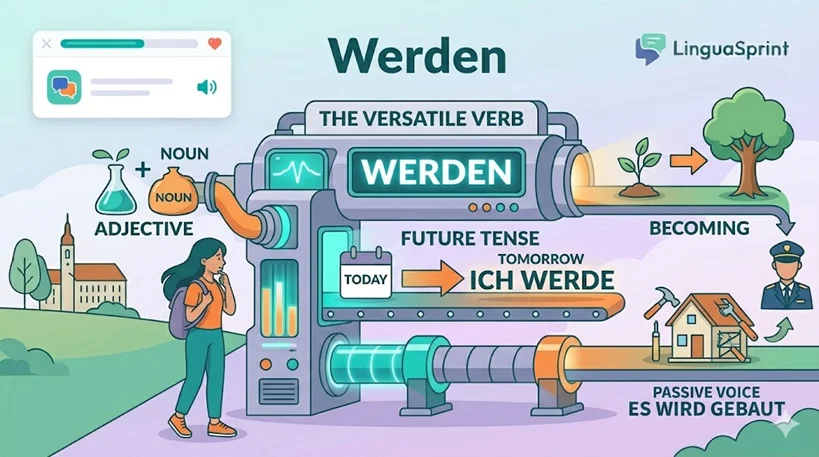
You've probably seen "werden" dozens of times and assumed you understood it. Then you noticed it appearing in sentences that seemed to have nothing to do with each other. That's not a coincidence — "werden" is one verb playing three entirely different grammatical roles. And knowing which one you're looking at changes everything.
If there is one verb in German that quietly underpins a huge portion of the language, it is "werden." It shows up in sentences about the future, in polite hypotheticals, and in structures where the subject isn't doing anything at all — it's having something done to it. Three different grammatical lives, one single verb.
Most learners encounter each form in isolation, at different points in their studies, without anyone pointing out the connection. This post brings all three together — so you can recognise "werden" in any sentence and know exactly what it's doing.
In its first life, "werden" is Germany's main way of expressing the future tense. Just as English uses "will" or "going to," German pairs "werden" with an infinitive sent to the end of the sentence.
One thing worth knowing: Germans often use the present tense for future events when the context makes the timing clear — "Ich fahre morgen" (I'm going tomorrow) is very common. "werden" tends to appear when there's more emphasis on the future nature of the event, or when expressing a prediction or promise.
| Pronoun | werden | Example |
|---|---|---|
| ich | werde | Ich werde lernen. |
| du | wirst | Du wirst sehen. |
| er / sie / es | wird | Es wird regnen. |
| wir | werden | Wir werden gewinnen. |
| ihr | werdet | Ihr werdet es verstehen. |
| sie / Sie | werden | Sie werden kommen. |
"werden" + infinitive at the end = future. The infinitive always gets pushed to the very last position in the sentence — treat it as your signal that something future is being discussed.
In its second life, "werden" transforms into "würden" — and this is German's way of saying "would." It is the backbone of polite requests, hypothetical scenarios, and wishes. If you've ever wanted to say "I would like to…" or "Would you…?" in German, this is your structure.
The "würden + infinitive" structure is the most practical conditional construction in everyday German. It works for almost any verb and sounds natural in both spoken and written language. When in doubt about how to express "would," this is your safest and most versatile tool.
Germans tend to communicate more directly than many other cultures — but polite indirectness is still valued in formal settings, customer service, and professional contexts. Knowing "würden Sie…?" vs. "Können Sie…?" vs. "Öffnen Sie!" is the difference between sounding courteous, neutral, or demanding. "würden" is your politeness lever.
"würden" = "would." The ü vowel shift is your visual cue that you've moved from future tense into conditional territory. Future: "werde/wird/werden." Conditional: "würde/würdest/würden."
In its third life, "werden" builds the passive voice — one of the most important structures in written German, formal communication, and news language. In passive sentences, the subject is no longer doing something; it is having something done to it.
The passive is especially common in German bureaucracy, formal letters, newspaper articles, and official signage. When you read "Es wird gebeten…" (You are kindly requested to…) or "Das wird bearbeitet" (This is being processed), you're reading passive constructions. Recognising them helps enormously with reading comprehension in real-life Germany.
"werden" + past participle (ending in -t or -en) = passive. The key signal is the past participle at the end of the clause. If the word at the end looks like "gemacht," "gesagt," "geschrieben," "untersucht" — you're reading a passive sentence.
"Das Paket wird geschickt" (passive: the package is being sent) vs. "Ich werde das Paket schicken" (future: I will send the package). Both use "werden" — but the verb form at the end tells you everything. Past participle → passive. Infinitive → future.
Here is the single most useful rule in this entire post. In all three uses of "werden," something gets sent to the end of the sentence. What that word looks like tells you exactly which "werden" you're dealing with:
Future and conditional both end in an infinitive — so how do you tell them apart? By the form of "werden" itself: "werde / wird / werden" = future. "würde / würdest / würden" = conditional. The ü is your switch.
Same topic — a job application — through all three lives of "werden."
Understanding "werden" in all three roles is not an academic exercise — it has immediate practical value in Germany.
Once you're comfortable with these three uses, the next level is "werden" in the past tense passive: "wurde gemacht" (was made/done) vs. "wird gemacht" (is being made/done). Same structure, different tense of "werden" — and a very natural next step once this post clicks.
"werden" is one of those verbs that reveals how much grammatical work a single word can carry. Once you can identify it in any sentence — future, conditional, passive — you've unlocked a significant portion of written and formal German. Three lives, one verb, one key insight: always look at what comes at the end of the sentence.
Want to practise all three uses of "werden" in real sentences and contexts? Deutsch-Assistent puts grammar into life.
Practise "werden" →