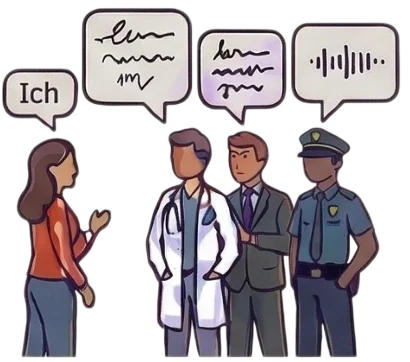
Why Conversation Practice Changes Everything
You can know every grammar rule and still freeze when the cashier at Aldi asks "Kassenbon?" You can ace every flashcard quiz and still panic when your landlord calls about the Nebenkostenabrechnung.
That's because knowing grammar and using grammar are two completely different skills. Conversation practice bridges that gap. It puts you in realistic situations where you need to recall vocabulary, apply grammar, and respond under (gentle) time pressure — exactly like real life, but without the embarrassment.
20+ Real-Life Scenarios
Every scenario is designed around situations you'll actually encounter in Germany:
- Daily Life: Café, supermarket, restaurant, pharmacy — ordering, paying, asking for help.
- Travel: Airport, train station, taxi, hotel — checking in, asking for directions, handling delays.
- Official Business: Bank, post office, doctor — opening accounts, sending packages, describing symptoms.
- Social: Meeting people, phone calls, invitations, dinner parties — small talk and beyond.
- Professional: Job interview, school enrolment, rental apartment — formal register and negotiation.
Choose a specific scenario or select "Random" to be dropped into a surprise situation. The AI sets the scene, plays the other person, and you respond naturally in German.
How the AI Helps You Improve
The conversation flows naturally — it's not a quiz. But after each exchange, the AI subtly corrects your German. Did you use the wrong case? The AI shows you the correct version. Did you use a clunky phrase? It suggests a more natural alternative. The conversation keeps going — learning happens in context, not in isolation.
At the end of each scenario (typically 6-8 exchanges), the AI provides a summary of your strengths and areas to improve. This feedback loop is what makes practice effective.
Frequently Asked Questions
Ready to Start Talking?
Pick a scenario. The AI sets the scene. You just speak German.
Start Conversation Practice →